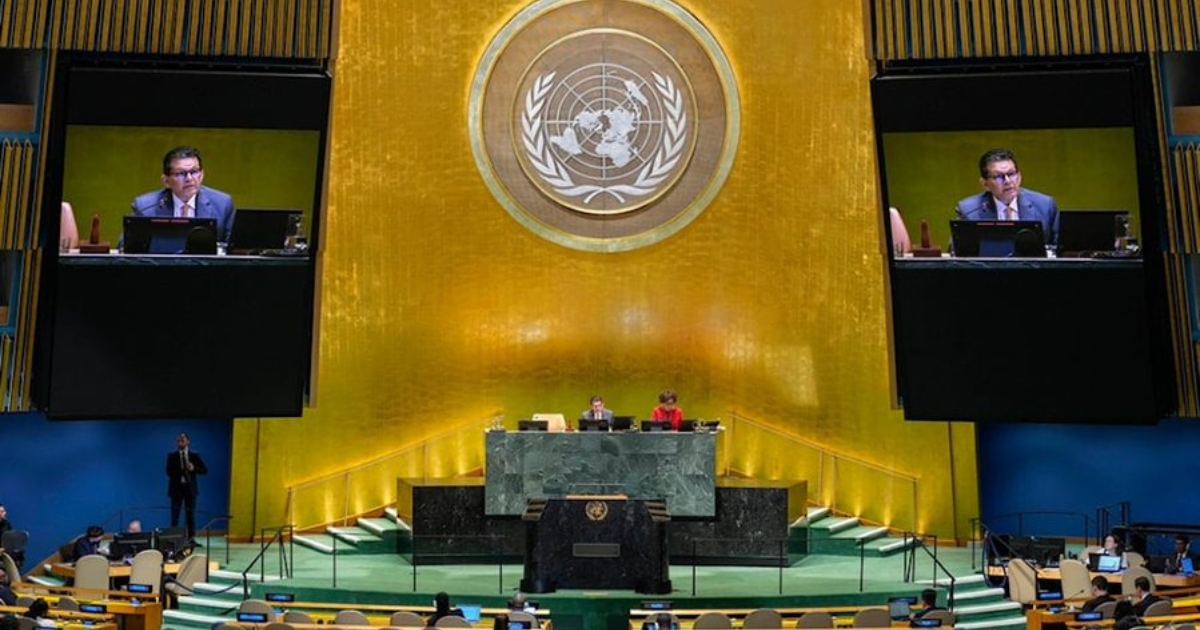
A gathering of some 130 heads of state and government will be addressing the United Nations General Assembly, where conflicts are heating up in Iran, Gaza, Ukraine, Sudan, the Democratic Republic of Congo and Myanmar. Leaders are getting more and more questions regarding the organization’s realistic capacity to contribute to the resolution of these crises.
In addition to the global conflicts, climate shocks, growing inequalities and trade disruptions are dominating the agenda. Global shipping disruptions and disrupted supply chains are inflating costs and blunting growth around the world.Worldwide shipping slowdowns and disrupted supply chains are costing higher and slowing down growth around the world. Moreover, the evolution of artificial intelligence is becoming a serious issue, with urgent calls for the need of international protection.
The meeting comes at a critical time for the venerable institution, which is 81 years old. The UN is under severe budget constraints and even more powerful calls for institutional change, especially in the United Nations Security Council where five permanent members have a veto.
There are several high-profile speakers from around the world. Secretary-General Antonio Guterres will make an opening statement, after which the French President, Emmanuel Macron of the Élysée Palace, and the US President, Donald Trump of The White House, will take the floor.
The President of Ukraine, Volodymyr Zelensky, will address the conference along with the President of Iran, Masoud Pezeshkian, whose communications team was reportedly blocked from getting US visas. Later in the week, Israeli Prime Minister Benjamin Netanyahu will speak to the assembly, with a video message from Palestinian President Mahmoud Abbas, who was refused a U.S. visa for the second year in a row. But the Chinese President Xi Jinping, the Russian President Vladimir Putin and the Indian Prime Minister Narendra Modi are not present. French UN Ambassador Jérôme Bonnafont highlighted the event as an important moment to focus on cooperation and multilateralism over confrontation.
One major issue that continues to be at the heart is financial and institutional difficulties. The United States recently made a payment of $725 million to the United Nations to help relieve immediate financial pressures, but the organization is seeing very significant reductions in the funding of peacekeeping and humanitarian initiatives. Moreover, the fate of who will replace Guterres is uncertain when he is set to come to an end on December 31 of his second term.
AI will be the star of the week as it moves forward. The Security Council will then hold discussions on AI governance, after a high-level meeting on Ukraine. As major tech giants have urged a temporary halt to AI development, President Trump has called for increased progress, asserting that he does not agree “they” (his “they”) are worried about.As the heads of big tech companies have asked for a temporary halt to AI development, Trump says he doesn’t think “they” (his “they”) are worried and wants to continue to move forward to remain ahead of the curve with China. But in the middle of these pivotal discussions are hundreds of bilateral talks across New York designed to create the conditions for future diplomatic negotiations over some of the most pressing challenges of our times, such as rising sea levels, education and gender equality — all in a world of great uncertainty