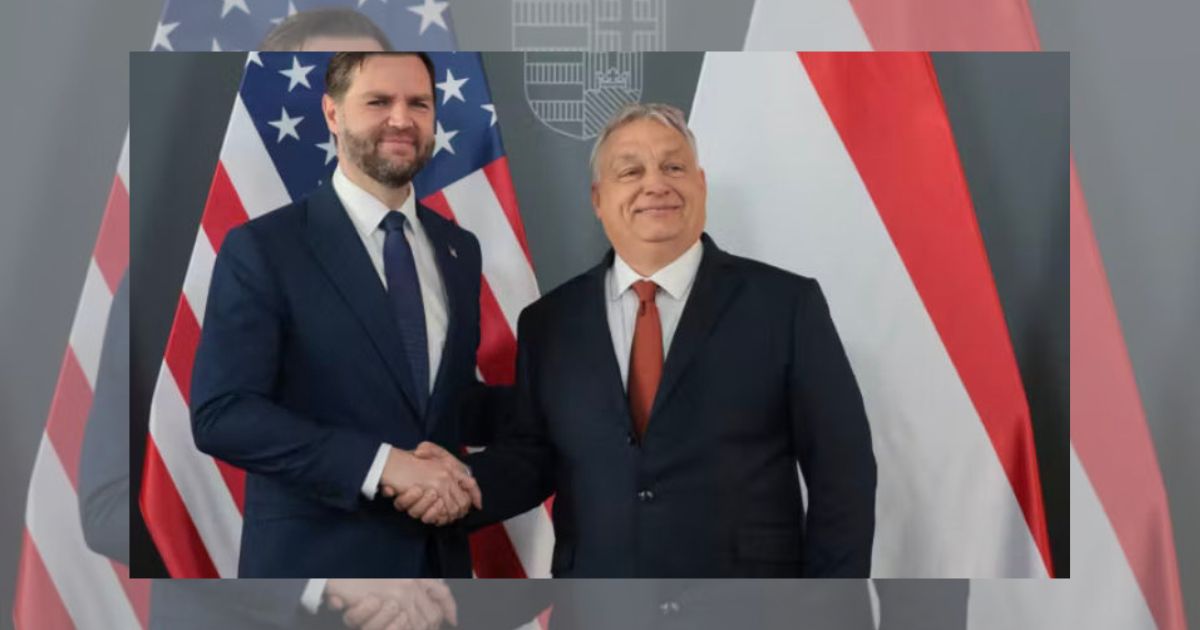
Just five days before Hungarians cast their ballots in an election that may oust Viktor Orbán, who has ruled the country for 16 years, the US Vice-President JD Vance has intervened in the campaign to give the Hungarian prime minister a resounding endorsement, and in the process, another volcanic attack on the EU.
Vance, standing next to Orbán, said that he was there in Budapest “to assist him in this election cycle” but admitted that the US would “cooperate with whoever wins this election.”
There is a clear lead of PE Magyar, the main opponent of Orbán, in the majority of opinion polls.
The longtime prime minister is one of the most important European partners of the Trump administration, and the closest partner of Russian President Vladimir Putin in the EU.
After winning four elections in a row since 2010, Orbán faces the toughest challenge in a political career going back almost 40 years.
As a desperate effort to give the prime minister a boost in the 12 April vote, Vance and his wife, Usha, visited Hungary in the first high-level US visit to the country in 20 years. Foreign Minister Péter Szijjártó greeted them and added that Orbán had become friends with President Donald Trump, a fact that had established a “new golden age” in bilateral relations.
The visit was met with a response by Péter Magyar, who said his Tisza party was happy to see Vance in Budapest and that his party would look at the US as a key partner, not only as an ally of NATO but also as an economic partner.
After negotiations with Orbán, Vance went on a scathing spurt at the European Union and Ukraine.
He charged the EU with “having one of the worst instances of foreign interference in elections that he had ever witnessed or even heard about… since they despise this guy.”
Vance also explained that “one of the reasons” he had visited was because the “interference that has been brought about by the bureaucracy in Brussels has been distasteful.”
Speaking later at an Orbán campaign rally, he said: “The idea here is for you to make up your mind regarding your future without any external influence or pressure. I am not suggesting whom you should vote for; however, what I am saying is that the civil servants at Brussels shouldn’t be obeyed.”
He concluded his speech by asking the audience “to turn up and vote at the weekend, support Viktor Orbán, as he represents you.”
Weeks of frustration have been caused by Orbán refusing to allow billions of euros of vital funding to Ukraine despite having signed this funding into law last December. Chancellor Friedrich Merz of Germany said of “a flagrant betrayal.”
They have, however, taken great caution not to be caught in the Hungarian election campaign.
The statements of Vance were similar to one made in Munich in February 2025, in which he accused European leaders of imposing restrictions on freedom of speech.
He also made unsubstantiated claims of Kyiv becoming a participant in the election campaign, without elaborating, claiming that they have attempted to have their thumb on the scale of American and Hungarian elections. This is just what they do.
Orbán has turned his hostility towards Ukraine and its president, Volodymyr Zelensky, into a part of his campaign.
When the government of Serbia – Hungary’s neighbour to the south – announced that explosives had been found and neutralised near the TurkStream gas pipeline, close to the border with Hungary, Orbán and pro-government media labelled the incident a terror attack on Hungary’s energy supply. Ukraine was quick to announce that it had nothing to do with the incident, indicating that it was a Russian false-flag operation.
Opposition leader Péter Magyar and former intelligence sources in Hungary linked Orbán with orchestrating the incident with the assistance of the Serbian President, Alexander Vucic, to increase his likelihood of re-election next Sunday.
The friendship between Trump and the Hungarian leader dates back to 2016, when Orbán was the first and the only EU leader who assisted Trump in his presidential campaign in the US. He has heavily supported Trump in his re-election in 2024 and visited Washington in October last to negotiate an exemption of Hungary from the US sanctions against Russian oil companies Rosneft and Lukoil.
Trump later clarified that the exemption was a special arrangement between him and Orbán – he would have to reapply should Orbán lose this election.
He addressed people at the campaign rally of Orbán on Tuesday, calling in on speakerphone after being called by Vance, who said that the prime minister was a fantastic man and that the two had a fantastic relationship.
Hungary, almost alone among EU countries, has defied calls from Brussels to wean itself off Russian fossil fuels. In Washington, Orbán also committed to buying more US liquefied natural gas (LNG), as well as US nuclear technology and fuel. Hungary is highly reliant on eastbound Russian oil via the Druzhba pipeline and southbound Russian gas via the TurkStream pipeline.
These two sources have now become problematic. Since the beginning of January, no oil has passed Hungary via the Druzhba pipeline, passing through Ukraine. On 27 January, Russia attacked oil infrastructure in western Ukraine, which caused an interruption of the pipeline supply; Orbán accused Ukraine of not fixing it.
In an effort to avoid shortages, Hungary has had to tap into oil stocks and import non-Russian oil by using an alternative pipeline in Croatia.
His popularity also seems to have been dented by other recent scandals.
Top secret phone calls between Foreign Minister Szijjarto and senior Russian officials over the years have been leaked.
Transcripts suggest that Szijjártó regularly keeps the Russian government informed about confidential discussions at European Union summits, and lobbied to get Russian officials off the sanctions list at Moscow’s bidding. Szijjarto has justified the calls as usual diplomacy.
Orbán has been accused by the European Parliament of running a “hybrid regime of electoral autocracy”, and Hungary is now assessed as the most corrupt country in the EU by Transparency International. Members of the inner circle of Orbán have been given big state projects, and his supporters have purchased up the main media companies.
Billions of euros of EU funding have been withheld from the government because of concerns over failings in the rule of law.