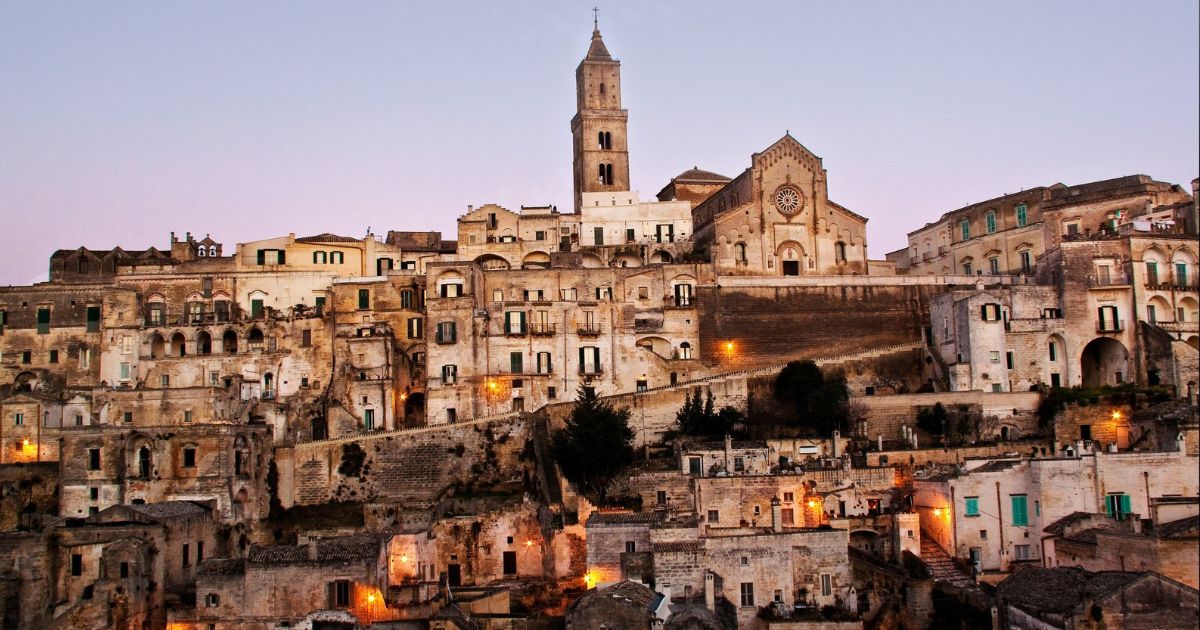
This year, the city of Matera, in the south of Italy, well away from the sea, becomes the intersection of Mediterranean artists as a result of exhibitions, concerts, and artistic residencies. The city will be the Mediterranean Capital of Culture and Dialogue 2026, and organisers state that the program will seek to foster avenues of communication in an area that is becoming synonymous with a state of war, migration and political polarisation.
The ancient cave dwellings of the Sassi dominate the view from the Sassi, instead of the sea, pale rock, scrub and ravines. The Mediterranean as a whole is evoked in the year’s programme through art, music, ancient languages and throughout centuries of migration.
Vast liquid continent
The Mediterranean, a ‘liquid continent’, which carries millennia of history and culture, is the subject of the Matera Basilicata 2019 Foundation‘s general director Rita Orlando.
The project is “cultural diplomacy”, Orlando said, and it’s an idea that he believes can bridge understanding where traditional diplomacy falls short.
Michelangelo Pistoletto’s “Love Difference” in Complesso Rupestre Madonna delle Virtu e San Nicola dei Greci is a mirrored table that forms the shape of the Mediterranean. It is surrounded by chairs representing the cultures of the oceans around the sea.
Language and migration
The residency by the musician and composer Stefano Saletti is an homage to Sabir, the language of the Mediterranean ports, which is based on Italian, French, Spanish, Arabic and local languages. It was the language of what might happen in the Mediterranean, Saletti added. The project contains a musical and a dramaturgical text featuring Matera and its history and engages the participation of artists, actors and other inhabitants of Matera.
Driant Zeneli is an Albanian visual artist and film director from Matera, who has been studying traditional songs from the Arbëreshe communities of Basilicata, the ancestors of which arrived from all over the Adriatic centuries ago. An example of a song in polyphonic style that focuses on the theme of women, wheat and the seasons is taken from San Costantino Albanese. It has been reworked in a video installation, which illustrates its meanings as memory and culture are transmitted from generation to generation through migration.
Exhibitions throughout the city
“The Sea Is Closer Than You See” is open from Oct. 3 until Dec. 8 in a citywide exhibition at four locations in Matera. It offers multiple perspectives on the region as a mosaic of cultures, rather than as a single, homogeneous one, by emphasising the links created by movement, memory, and shared practice.
Matera’s Museum of Contemporary Sculpture (MUSMA) e Studio Azzurro’s “Il Colore dei gesti”. Sinfonia Mediterraneo” are inspired by the gestures of fishermen, potters, luthiers, weavers and other craftsmen. Another project, TEMET, developed out of the research in the Tassili n’Ajjer region of Algeria, and involved the integration of photographic and technological approaches with the knowledge of the Tuareg communities of that region, to examine the rock art of prehistory and the histories of migration and trade.
Mimmo Jodice’s “Mediterraneo” is a collection of photographs from Italy, Greece, Türkiye, Tunisia and Jordan. The exhibition does not simply portray the sea as a border but as a space that becomes a common space of culture.
The music reflects current events
On Oct. 2, at the concert “Suoni Mediterranei,” the Italian and Moroccan musicians performed the music of the Arab-Andalusian tradition, mixing it with Italian strings. The performance was part of a partnership with Matera’s partner this year, the Mediterranean capital of Tetouan, Morocco.
Karen Keyrouz, Lebanese artist and illustrator currently in Matera for an artistic residency, said that the Mediterranean “appears” in her drawings in the form of water and the sea, and is often intertwined with the image of the city that is in imminent danger.
Culture amid conflict
But cultural diplomacy is not about ignoring or being naive about the conflicts that have erupted around the Mediterranean, which is often perceived through the lenses of war, trafficking and migration, Orlando said. Instead of seeing differences as a barrier, it is “taking off the notions, listening and being ready to understand differences”, she said.
Linguistic barriers were overcome in ancient times by accessing vocabulary from various languages within the context of Sabir in Mediterranean communities. Matera’s 2026 programme asks if culture can provide one of these languages of encounter in a part of the world where conflict and division are frequently the topics of discussion.