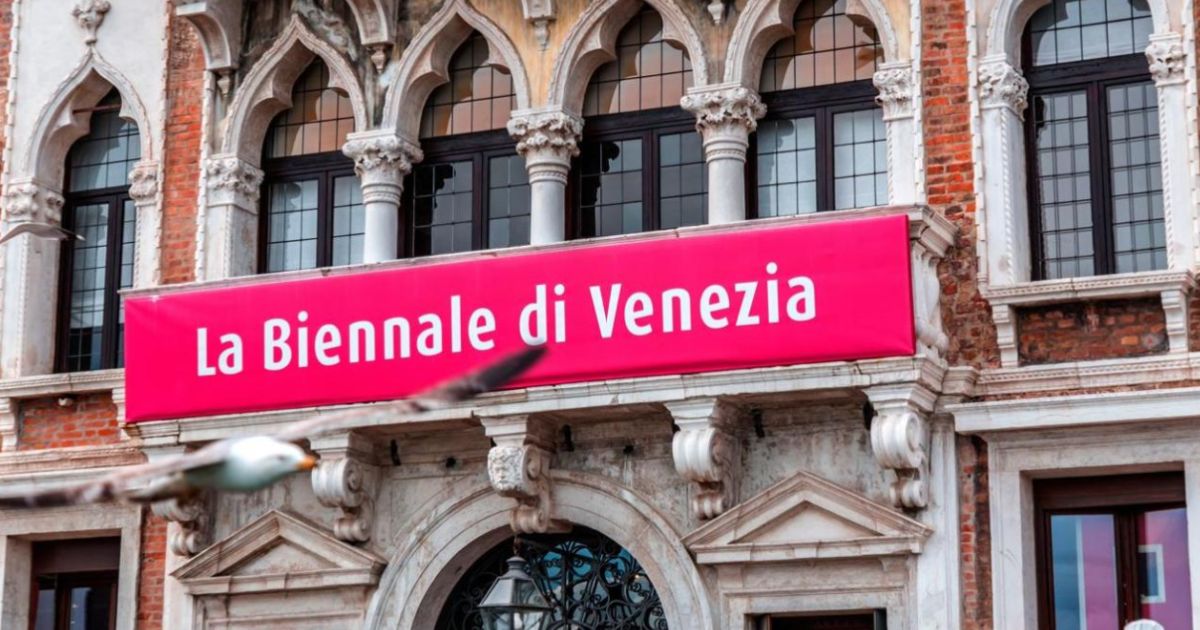
At the 61st Venice Biennale, the Hungarian pavilion was opened with an exhibition of Koronczi Endre, Pneuma Cosmic (Cosmic Breath). The public will be able to visit the exhibition from 9 May.
The project is based on a fictional research concept that considers the manifestations of airflow that permeate the entire world. The exhibition consists of three installations, exploring the artistic possibilities of capturing air currents and parallelising phenomena of the physical world with the immaterial spiritual.
At the opening ceremony on Wednesday, the director of the Ludwig Múzeum and national commissioner of Hungary’s participation at the biennale, Julia Fabényi, said that the exhibition was the outcome of almost 20 years of empirical observation and collection.
In the body of the work, she said, ‘we enter a kind of “museum of breath”, focused on breathing, respiration and pneuma’, the central challenge of the project being the visualisation of an invisible force.
Fabényi also added, “it is the 10th anniversary this year that the Ludwig Museum is supervising Hungary’s participation at the biennale, and he appreciated the work of the curatorial and coordination team behind the pavilion.”
“It is a success to show the concept of breath and slowing down with three different methods of art in the exhibition,” said deputy state secretary for cultural development Máté Vincze at the Ministry of Culture and Innovation.
The artist connected the piece to the theme of this year’s biennale, In Minor Keys, whose theme is “introspection and slowing down”. Vincze: ‘Through a deep breath, we can come back to ourselves, to the world around us and to our inner world.
Pneuma Cosmic investigates air in microcosmic and macrocosmic dimensions, in which air is conceived as an invisible yet constant medium that animates the world, explains the curator Luca Cserhalmi.
In addition to other components of the exhibition, a part of an historic ventilation system taken from the MTA’s 200-year-old headquarters, a video installation that chronicles a year-long stroll searching for ‘the most important sight’ and an integrated ‘breathing wall’ within the pavilion itself.
Together with the installation, there is an acoustic composition by Máté Balogh, which explores the dialogue between nature and transcendence through the use of sound.
Endre Koronczi was born in 1968 in Budapest and currently lives there as well, where he teaches at the Eszterházy Károly University’s Institute of Media and Design, and works as an interdisciplinary artist. His art is a fusion of conceptual concepts and poetic sensitivity, frequently concerning the relationship between people, daily life and emotions.
This exhibition will be open to professional visitors and will be available to the public from 9 May until 22 November at the Venice Biennale.