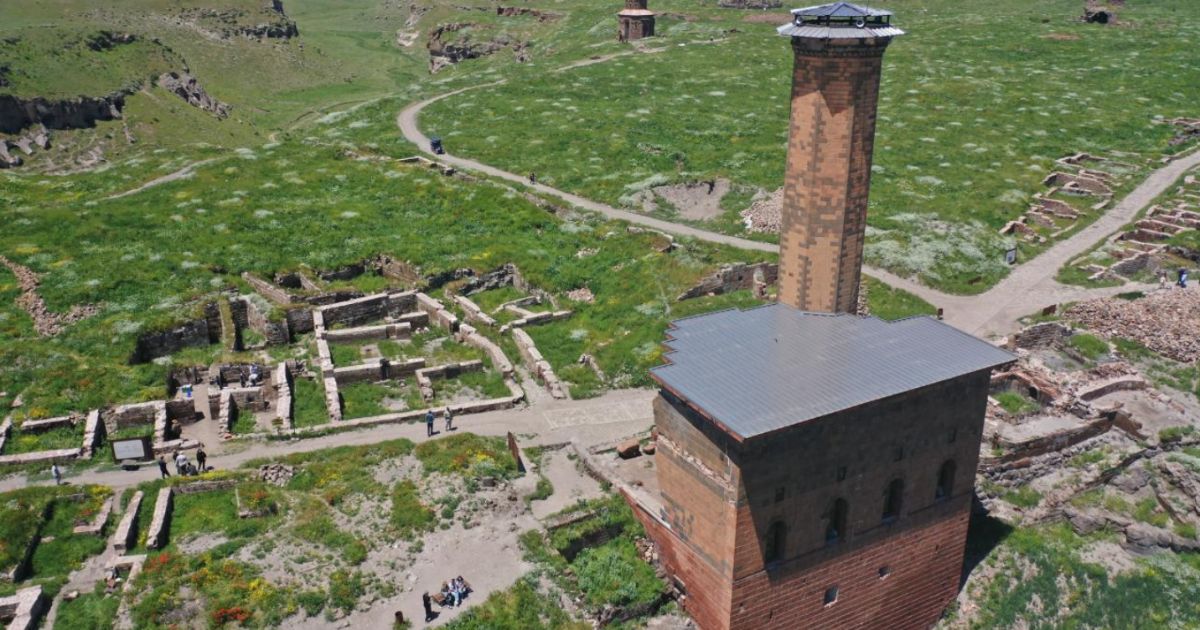
Teams are excavating at five locations in the tourist hub of Ani, the UNESCO-listed archaeological site in Kars, to excavate movable and immovable materials associated with each of the city’s layers of medieval history.
Ani is in the eastern part of Türkiye, where it is said to be one of the main gates of the way of life from Central Asia to Western Asia and the Caucasus to Anatolia.
Significant Turkish-Islamic architecture from the 11th and 12th Centuries is represented within the site, and the history is told of the Bagratid Dynasty, Byzantium, Great Seljuks, Georgian Kingdom, Mongols, Ilkhanids, Karakoyunlu and Akkoyunlu and Ottoman Empire.
Work focuses on Ani’s Seljuk-era urban life
The works are being conducted in cooperation with the Culture and Tourism Ministry and the Kafkas University. A team of 100 members of the archaeological and art-historical, as well as architects and restoration architects, is digging underground to expose historical structures and artefacts.
Ani Excavation Head Assoc. Prof. Muhammet Arslan stated that it was one of the greatest cities of the Middle Ages and especially became significant after the Seljuk conquest.
He said Ani was the gateway of the Turks into Anatolia when the city was conquered by Seljuk Sultan Alparslan in 1064, and Turkish-Islamic history also started from that city.
Ani, with its mosque, masjid, bath, bazaar and examples of civil architecture, is a city where the first examples of Turkish-Islamic civilisation, which marked the beginning of Turkish-Islamic architecture in Anatolia, can be seen, Arslan said.
Excavations Also Provide Conservation and Visitor Planning
Arslan said that the work on the fifth of the five sites is ongoing this season, including the Seljuk bazaar, the residences of the Seljuqs, the Seljuk cemetery, as well as the oil production facility, one of the spaces associated with Ani’s rich commercial life.
The team is not just conducting excavations, he added, but is also on the conservation task. Preservation of architectural remains removed from the ground continues, as do the environmental arrangements.
In this context, within the city walls, walking routes were being developed, which will provide a more comfortable route for visitors in the city and facilitate the management of visitors in the site.
Ani remains one of Kars’ main tourism routes
Arslan reported that Kars has been able to gain momentum in the tourism sector in recent years, with Sarikamis, Cildir Lake and the historical texture of Kars city centre as the main routes.
Ani is still today, said A., the most significant archaeological site in the city. Higher numbers have also been a result of the long-term excavation, conservation and environmental works that now take place almost year-round.
In 2025, Arslan said that Ani saw a record of nearly 450,000 visitors. He said that work will be ongoing in 2026 in an effort to push that number up.