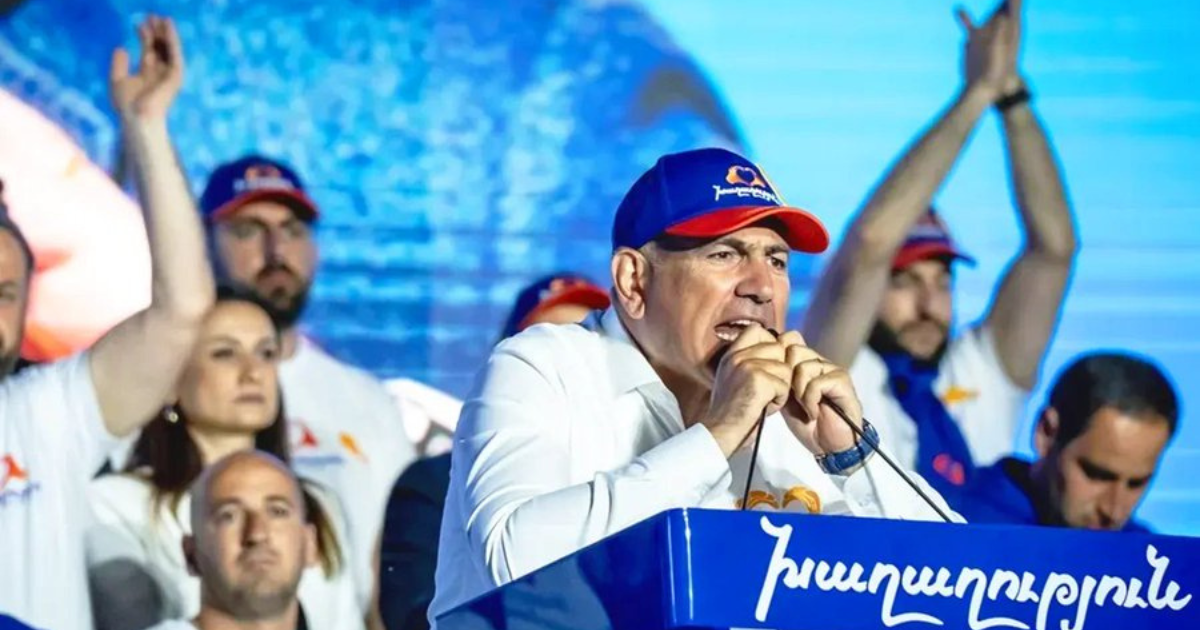
On June 7, the Armenians will go to the polls in a pivotal election that will decide whether they will continue on the road to the West or back to Russia, their traditional ally. The Government of Armenia headed by Prime Minister Nikol Pashinyan is looking to get re-elected through promises of closer European integration despite rising economic risks from Moscow.
Since 2018, when Pashinyan took power, he has energetically moved Yerevan away from the Russian influence. He started the ball rolling on the path to EU membership, and pushed forward a US-led peace deal with neighboring Azerbaijan – recently endorsed by the White House.
Yet, Pashinyan’s domestic approval has significantly dropped from 54% in 2021 to about 30%. The concessions by the government in response to Azerbaijan’s military conquest of the Nagorno-Karabakh territory in 2023 have left many voters “very displeased.The government’s concessions after Azerbaijan’s military take-over of Nagorno-Karabakh in 2023 have angered many voters, who are “very displeased.
Pashinyan has a narrow lead in a divided opposition that includes former leaders as well as billionaire Samvel Karapetyan, who is backed by Russia. His party, the Civil Contract, is at 32% according to a recent poll by the International Republican Institute, but 40% of people have no trust in any political figure.
Moscow’s Economic Retaliation and EU Support
The Kremlin stepped up its economic pressure campaign in a big way during the election. Weeks before the vote, Russia, the biggest trading partner of Armenia, prohibited importing of Armenian agricultural products, mineral water and cognac.
Also, Russian leadership noted Armenia’s dependence on Russian natural gas, which is sold at a significantly subsidized price. President Vladimir Putin gave point to Armenia’s warning against European integration and urged the country to have a referendum on leaving the Russian-led Eurasian Economic Union.
While Armenia has managed to diversify its military imports away from Moscow, its economic fragility still works as a kind of leverage , for Russia. As a reply to this sort of coercion, the European Commission promised €50 million in order to help Yerevan cover for the trade bans, and it did so while openly condemning Moscow’s use of commerce as a political tool .
But, even with European money, Pashinyan’s “Real Armenia” movement has been beset with tension, confrontations with the displaced, and opposing claims of government intimidation. In the end, voters will have to determine whether a distant future in Europe is worth enduring near-term and very real economic suffering.