The delegation of Iran has reached Pakistan to negotiate a ceasefire with the United States, since Tehran insisted on a ceasefire in Lebanon and freeing its frozen assets to develop the talks.
Late on 10th April, the Pakistani Foreign Office announced the Iranian delegation is headed by the Parliament Speaker Mohammad Bagher Ghalibaf and included Foreign Minister Abbas Araghchi, the Secretary of the Defence Council, the Governor of the Central Bank of Iran and parliamentarians.
The Iranians received Pakistani Deputy Prime Minister and Foreign Minister Ishaq Dar, Chief of Defence Forces Field Marshal Asim Munir and others.
Ahead of their arrival for the historic talks, US Vice President JD Vance warned Iran not to try to “play” Washington as he headed to Islamabad to represent the United States.
Although a temporary truce has been called between the rivals, great differences still exist on the path of negotiations that will see the temporary ceasefire changed into a permanent peace agreement.
Pakistani PM Shehbaz Sharif remarked that it would be difficult to achieve progress.
“Raising a temporary ceasefire,” he said, “but now a more complicated phase of reaching a lasting ceasefire, of solving complicated issues by means of negotiations, lay ahead.”
“This is that step which, in English, is known as the equivalent of make or break.”
Iranian state television reiterated the Iranian stand that negotiations would only commence after Washington had conceded to its conditions, which included a Lebanon ceasefire and release of its assets.
Israel still violated the truce and launched air attacks in Lebanon on Friday, and the State Security agency of Lebanon reported that an attack on the southern city of Nabatiyeh had killed 13 of its staff.
The health ministry of Lebanon, at the same time, increased the provisional number of dead due to huge Israeli attacks on the entire country on Wednesday to 357 people dead, and 1,223 injured.
The presidency of Lebanon announced that it would meet with Israel next week in Washington to discuss a ceasefire in the Israeli war against Lebanon and the possibility of negotiations between the neighbours.
Sticking points
Vance, who addressed reporters prior to flying to Islamabad, said: “When the Iranians are ready to negotiate in good faith, then we are prepared to gently extend the open hand.
But when they see that they are to attempt to play us, they will discover that the negotiating team is not so attentive as a listener,”.
According to the official sources, the discussions in Islamabad will touch on some of the delicate issues, such as the Iranian nuclear enrichment and the free movement of trade along the important oil route, the Strait of Hormuz.
With the ceasefire coming into effect, President Donald Trump has expressed dissatisfaction with the way Iran is managing the Strait, which had been closed, whereas Tehran has responded furiously to the ongoing Israeli attacks in Lebanon.
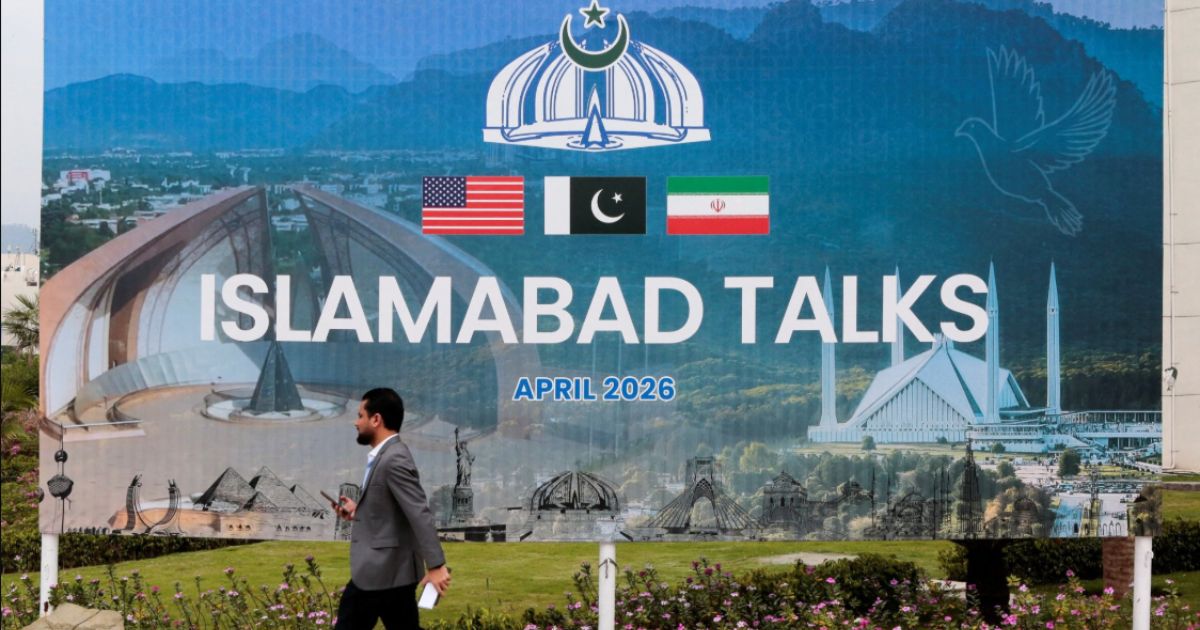
In Islamabad, the streets leading to the Serena Hotel, where the talks were to be held, were closed off and heavily guarded, and a big banner and electronic display signs set up by the expressway announced the “Islamabad Talks.”
Five of the world’s oil and huge amounts of natural gas and fertiliser flow through the Strait of Hormuz in peacetime, and only a few ships have crossed the truce, which was declared earlier this week.
The two-week truce was negotiated to give time to hold talks to bring to an end a war that has already claimed the lives of thousands of people and sent the world economy into a downturn.
On Friday, the Israeli military reported that Hezbollah had launched approximately 30 projectiles at its soil in Lebanon as Israel continued to mount attacks in Lebanon.
Hezbollah claimed to have “fired missiles at the Ashdod navy base of Israel in retaliation for the violation of the ceasefire agreement by the enemy and its frequent attacks on Beirut.”
Trump informed NBC News on Thursday that Israel was “reducing its strikes” in Lebanon and that Prime Minister Benjamin Netanyahu had assured him that its assaults would turn into more of a “low profile.”
In a condition of anonymity, a Western diplomat reported that there had been continuing “pressure by European states, Gulf states and Egypt on Israel to prevent a renewed Israeli air attack on Beirut following a repeat of the Israeli air attack on Beirut in Black Wednesday.”
Trump has also previously threatened that his nation is equipping warships with the best weapons ever created, stating that it could employ force in case of no agreement.