On 14th March, the Joint Chiefs of Staff (JCS) of South Korea announced that about 10 ballistic missiles were launched by North Korea into the Sea of Japan, several days after Pyongyang threatened “terrible consequences” in response to the continued South Korea-US military exercises.
Pyongyang has recently killed the hopes of a possible diplomatic thaw with Seoul, which is the security ally of Washington, calling its most recent peace talks a “clumsy, fake farce.”
According to JCS, a statement issued at 1:20 pm (0420 GMT), referring to the name of the body of water in South Korea, “the military there detected about ten ballistic missiles launched by the Sunan region of North Korea into the East Sea.”
The distance of the missiles, they said, was about 350 kilometres, and that the South Korean and US authorities are examining their specifications.
JCS added that “the South Korean military is prepared to retaliate in an overwhelming manner to any provocation.”
The defence ministry of Japan also attested that North Koreans fired several ballistic missiles with an altitude of approximately 80 kilometres and landed outside the sole economic zone of Japan off the east coast of the Korean Peninsula.
The presidential Blue House of Seoul denounced the launches as a provocation that contravened the resolutions of the United Nations Security Council and called on Pyongyang to halt such launches.
It has even prompted the concerned agencies to remain on a high level of preparedness since the launch took place during the joint US-South Korea military exercises.
The launches were hours following the comments of the South Korean Prime Minister Kim Min-seok, who made statements suggesting that the US President Donald Trump believed that a meeting between him and the leader of Pyongyang Kim Jong-un would be a good idea.
Over the decades, Washington has been at the forefront of destroying the nuclear programme of North Korea, yet the summits, sanctions and diplomatic pressures have had little effect.
With Trump set to visit Beijing later that month in late March, the Trump administration has been aiming at reviving high-level talks with Pyongyang, where a possible summit with Kim Jong-un may be held this year.
In October, Trump was on a visit to Asia, and he stated that he was 100 per cent willing to meet with Kim Jong-un, but the North did not reply.
Having mostly overlooked the overtures made by them over several months, Kim Jong-un recently remarked that the two countries could get along provided Washington conceded to the nuclear status of Pyongyang.
‘Terrible consequences’
The analysts reported that the number of missiles deployed on Saturday was odd and the timing was significant.
According to Hong Sung-pyo, a senior researcher at the Korea Institute of Military Affairs, “the world is now watching the war in the Middle East, and North Korea has long practised military provocations when it desires to get attention.”
“And that is probably the motivation of this launch, too,” he thought.
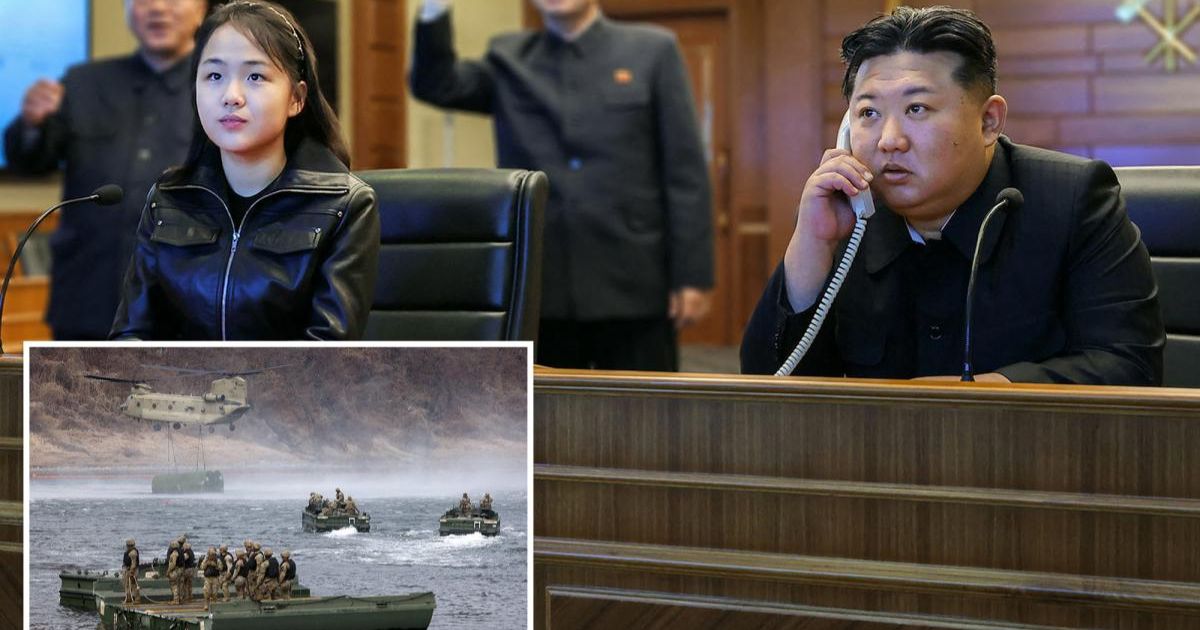
On Monday, Seoul and Washington began their springtime military drills, “Freedom Shield,” which will involve approximately 18,000 Korean soldiers and last through to the 19th of March.
Such exercises have long been described by the nuclear-armed North, which launched an attack on its neighbour in 1950 that kick-started the Korean War.
At the beginning of this week, Kim Yo-jong, who is a very influential confidante of her brother Kim Jong-un, stated that the joint exercises would have a “dreadful impact that is beyond imagination.”
She continued by saying that the drills were held at “a critical time when the global security structure is highly disintegrating at an accelerated rate, and wars erupt in various locations across the globe.”
The attack on Iran by the US-Israel has been labelled by Pyongyang as an act of aggression, which is illegal, and it demonstrates the rogue side of the United States.
North Korea too has just conducted missile tests aboard the naval Choe Hyon destroyer, saying that the country was arming the Navy with nuclear weapons.
North Korea has been investing more in its navy, with possibly the assistance of Russia. However, Leif-Eric Easley, a professor at Ewha University in Seoul, noticed that “the US could sink most of the Iranian navy in a week.”
“So Pyongyang will probably carry out tests and rhetoric of nuclear command, control and delivery systems to indicate that it might cause unacceptable damage in case its naval forces are attacked.”