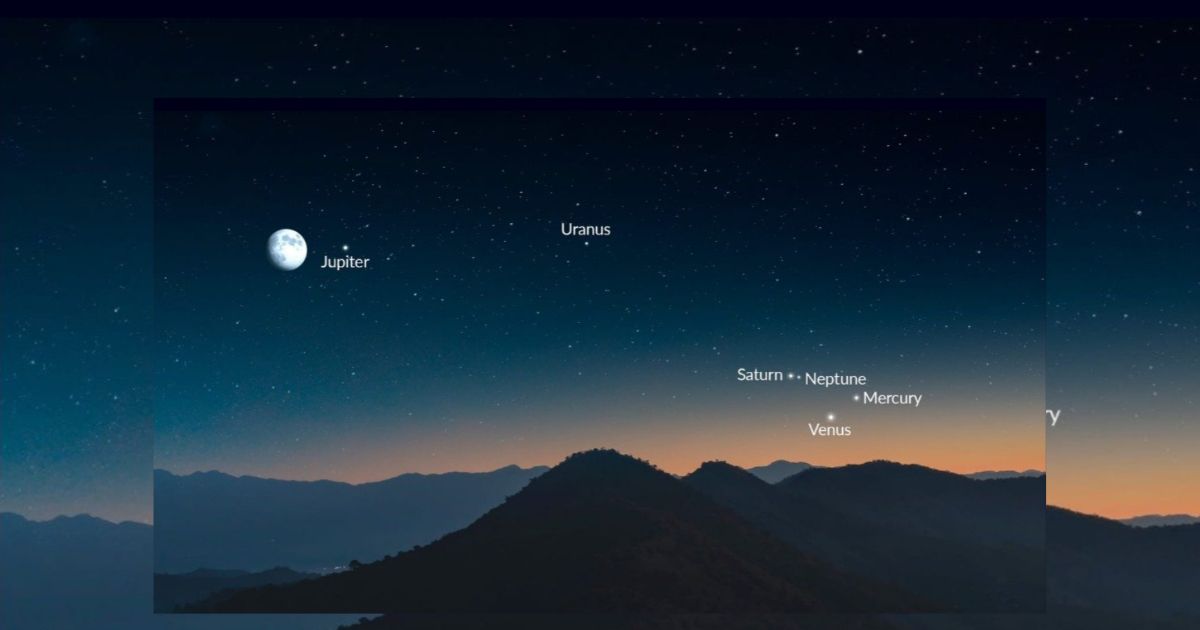
Over the upcoming days, Jupiter, Saturn, Venus, Mercury, Neptune and Uranus will all be visible concurrently during the night sky, though binoculars or a telescope will be necessary to view the last two planets.
NASA has also issued new sonifications, or astronomical data of its Chandra X-ray Observatory, as sound, of Jupiter, Saturn, and Uranus in honour of the occasion.
Dr Megan Argo of the University of Lancaster, who is a reader in astrophysics, said that it was a rare occurrence to see so many of these planets in the sky at the same time.
“We are witnessing this coincidence since the orbits of the planets have placed them in an approximate position in the sky as viewed by us, planet Earth. Every planet revolves around the sun at a different speed, and thus, they always change location with the stars in the background. Their tracks will coincide only here and there, and then they will put a number of them into our night sky,” she said.
“Although it is not uncommon to get four or five planets at a time, six are very rare. The seven were all seen together last year, and will not reappear once more in a complete line-up till 2040.”
On 28 February, Argo said, all six planets would be visible, which, however, would not last long, as Mercury would be more difficult to see by midweek, although Jupiter and Venus would be visible all along.
Argo recommended people to go out in the early evening of the day when they wanted to see the planetary parade, i.e. at 5.45 pm in the UK and 6 pm in the US and look out to the west, preferably on top of a hill with an unhindered view.
The sky will be seen as a curved line of the planets. The northern hemisphere will see Jupiter in the high southeast, where Mercury, Saturn, Neptune and Venus will be seen in a cluster near the horizon in the western sky.
The brightest will be Venus, which will be followed by a very faint Mercury, to its right, and Saturn and Neptune a small way above.
Argo responded that Uranus will be dim, and it will be under the cluster of stars called the Seven Sisters and a stargazing app on your phone will guide you to discover the planet.
Although the use of a pair of binoculars would also be useful, Argo explained that one should never observe the sun using binoculars or a telescope since this would permanently destroy one’s eyesight.
According to Dr Ed Bloomer, an astronomer at the Royal Observatory, Greenwich, the event would also be seen by the southern hemisphere and with a similar pattern, though the parade will be in reverse order of what will be seen by the northern hemisphere.
In Australia, Jupiter will be visible in the north, and Uranus will be visible in the north-west over the Seven Sisters. In Australia, the Sun goes to sleep a bit later in the day, and therefore, after 6.45 pm local time, it is time to go outside. Mercury, however, is so near the horizon at sunset that it will not be much seen in Australia, and Venus will be setting at 7.15 pm, so you will have to be prompt to see her.
She said: “We have the moon in the mix too, actually, tonight and the next couple of days. We have a fair share of the observable solar system, therefore.”