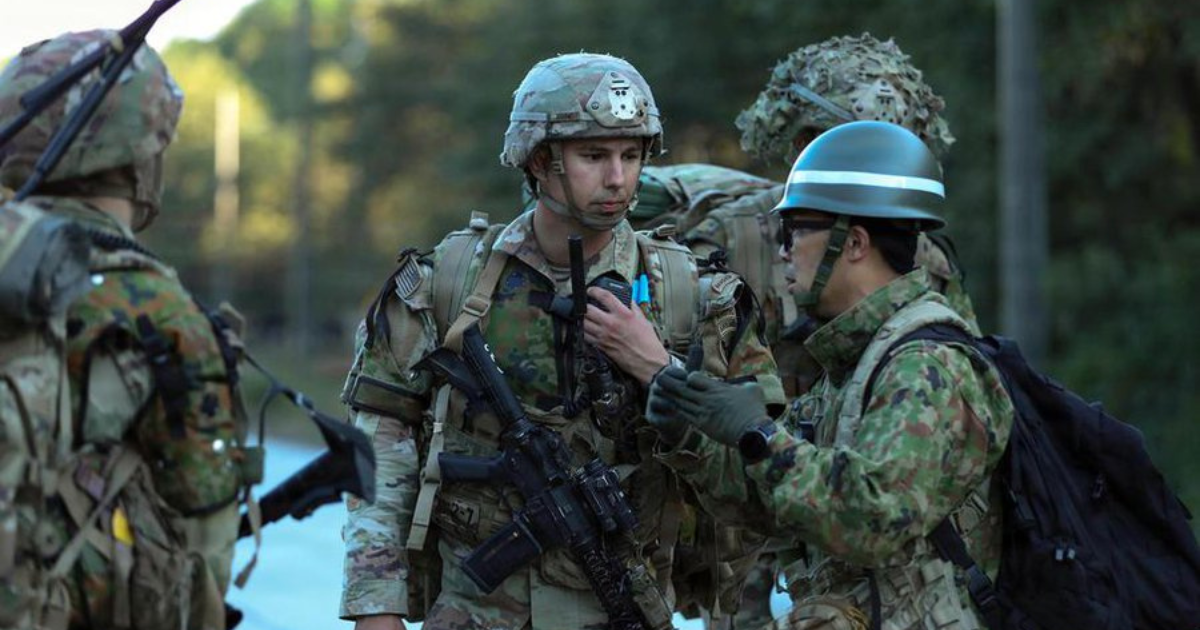
A key step in the U.S.-Japan joint military exercise “Orient Shield” was taken on Sept. 15 when the first-ever major field parachute drop training was held in Eniwa, Hokkaido. The two countries’ transport aircraft dropped 380 paratroopers – 260 from the U.S. Army 11th Airborne Division and 120 from the Japanese Ground Self-Defense Force 1st Airborne Brigade. The troops landed at an altitude of 340m and successfully practised ‘Rapid Insertion ‘, where troops are dropped into inaccessible areas or deep behind enemy lines.
This year’s Orient Shield is the largest in the exercise’s history with 3,700 people participating overall. The operation, closely coordinated with the Japan Ministry of Defense, also involved Australian forces, in order to further develop the trilateral defense cooperation. A further significant first for the drill was the new Maritime Transport Corps, which was integrated into Japan, being used for maritime mobility training. In this unit, troops and heavy equipment were successfully transported from Yokohama to the Nansei Islands, a strategically important area close to Taiwan that was vulnerable to any potential threat in the region.
The U.S. Department of Defense (DoD) also announced plans to deploy its “Typhon” mobile mid-range missile system in Kagoshima Prefecture, marking another step in greater military cooperation. The deployment, which has been in Japan since a June exercise, has raised the possibility of a permanent presence of the Tomahawk-capable system. Japan has been pursuing an aggressive Diplomacy of Multilateralism to deepen the security architecture in this region that is dominated by U.S. Indo-Pacific Command. To consolidate the Indo-Pacific region’s security architectures under the leadership of U.S. Indo-Pacific Command, Japan has expanded its multilateral partnership while aggressively. This includes the Reciprocal Access Agreements with Australia and the Philippines as well as routine “Freedom Edge” trilateral exercises with South Korea. The deepened cooperation is stark contrast to South Korea-U.S. “Ulchi-Freedom Shield” exercise that was reduced to five days, with its counterattack maneuvers cancelled by South Korean President Donald Trump.
The military co-operation among the liberal democracies’ growth has received critical condemnations from their rivals. The Far Eastern border exercises that Russia strongly opposed, to which the U.S. responded with “rigorous countermeasures” in the event that the U.S. deployed missiles in Japan, were conducted in Hokkaido. Likewise, officials from the Ministry of National Defense of the People’s Republic of China strongly condemned Orient Shield, stating that the drill was used to deceive the world and create an impression of an offensive deployment of the army’s forces and the pose of a threat to regional stability.