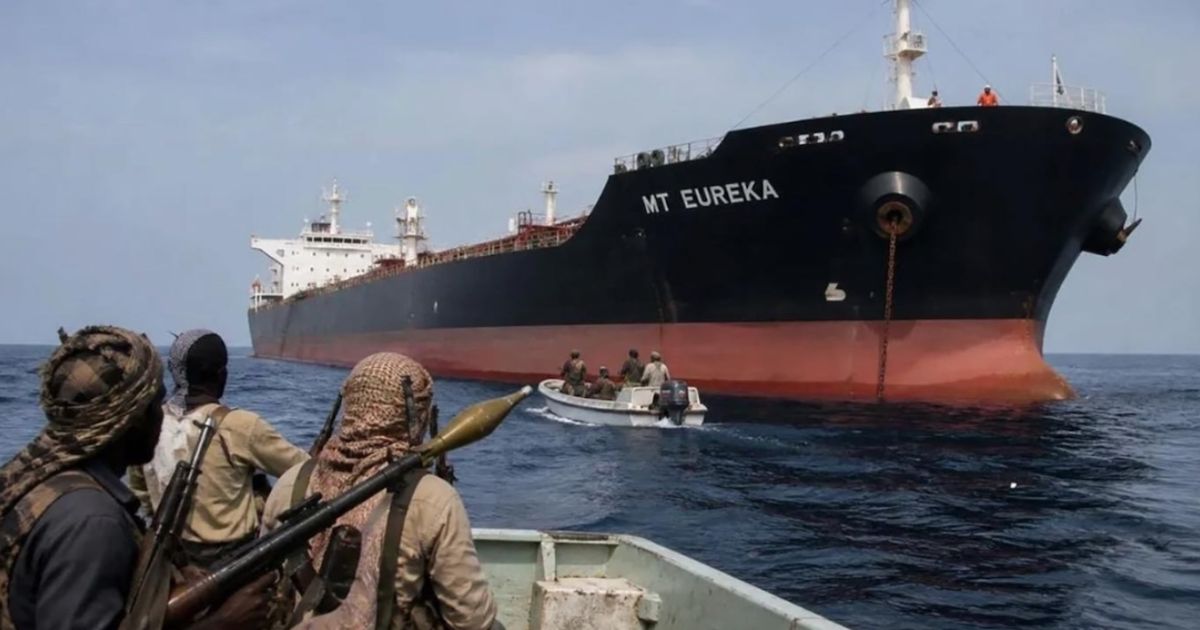
Now that ships are avoiding the war-torn Middle East, piracy off Somalia has returned. The resurgence is increasing insurance and shipping rates and security expenses, and is adding another burden to global supply chains.
This has been a nightmare two months for global shipping; the Strait of Hormuz has been mostly closed to commercial shipping, and the danger of new attacks on vessels in the Red Sea is present.
But a third crisis is unfolding, Somali piracy, which is making a comeback.
Before the latest tensions erupted between the United States, Israel and Iran, around half of those ships heading for Europe from Asia and the Gulf were already avoiding the Red Sea and Suez Canal because of previous attacks by the Iran-backed Houthis.
Major shipping companies chose not to go through the narrow Bab el-Mandeb Strait between the Red Sea and the Gulf of Aden, given the risk of attacks in the chokepoint.
The diversion extends the trip by two to three weeks and thousands of nautical miles, and puts ships right through Somalia’s waters, where Somali pirates carried out a year-long campaign of hijackings that reached its peak in 2011. They have been reported since then, in isolated incidents.
A disturbing resurgence of piracy
Sea piracy has returned with a vengeance in that stretch of sea, for in the last three weeks, three ships have been kidnapped off Somalia and surrounding Yemen. Cargo ship Sward, the Honour 25 and the Eureka oil tanker are still all controlled by pirates as of May 8, 2026.
Somalia’s hijackers are exploiting the Iran war, experts say, because international naval operations, which were launched in 2008 to combat the pirates, have been pulled thin as a result of developments in Hormuz and the Red Sea.
Tim Walker, the senior researcher for transnational threats and organised crime at South Africa’s Institute for Security Studies, states the pirates now feel a lack of deterrents along Somalia’s 3,300-kilometre (2,050-mile) long coastline – the longest of any coast in continental Africa.
Some groups apparently are now targeting ships and crew for ransom, sometimes demanding a large ransom for their safety, Walker said to DW.
But the European Union’s Operation Atalanta, a naval operation charged with guarding shipping off Somalia, does operate regularly, alongside the multinational Combined Task Force 151, in the western Indian Ocean. However, it is not an escort force and has to patrol large areas.
Well-funded pirates using dhows
There are at least two groups of pirates operating, mainly in the semi-autonomous northeast region of Somalia known as Puntland, according to maritime data company Lloyd’s List Intelligence. They seem to have adequate resources.
Large traditional boats called dhows, which are traditionally used for fishing and local trade, have been snatched by the pirates and converted to mother ships. These enable pirates to operate further from the coast and for longer periods at sea before being able to use them as a platform to attack commercial shipping.
Some of the most recent hijackings involved the use of large dhows, “which require navigation kits, weapons and boarding equipment,” said assistant professor Troels Burchall Henningsen at the Institute for Strategy and War Studies in Denmark. It’s a big deal that will need investment.
Walker noted that there are far more ships in the vicinity that are not taking “the best precautions. Walker said that one tanker that was bound for the Somali port of Mogadishu had been hijacked near the Somali coast, where it was most vulnerable.
Piracy may further increase shipping costs
Middle East wars and conflicts have already led to a 10% rise in shipping insurance premiums and freight rates, and if shipping insurance rates were to skyrocket again with a new bout of piracy, the industry will add even more dollars to freight rates and be sending a larger bill to the already overloaded global shipping lanes, shipping industry leaders warn.
At the height of the previous piracy crisis in 2011, the economic damage from hijackings was estimated at around $7 billion (€5.98 billion) a year, according to the Sasakawa Peace Foundation, a Japanese think tank.
This covered the expenses of the military operations, rerouting, accelerating (fuel consumption), extra security gear and crew onboard.
Only a tiny proportion of the overall cost, nearly $160 million, was paid out in ransoms, the think tank.
Development funds to Somalia cut
The Iran war provided an effective diversion for the pirates, but a policy change towards E. Africa by Washington may have also contributed to the renewed surge in piracy.
Development funding in Somalia – particularly in coastal areas – has been funded by the US for years in order to alleviate poverty and prevent young men from joining the pirate gangs.
As of today, though, almost all other development assistance by the Trump administration has been stalled. Instead, Washington has been focusing on an anti-al-Shabaab operation in direct combat.
The intelligence network and maritime patrols aren’t capable of doing the same, said Burchall Henningsen.
The maritime groups, meanwhile, have called on shipping companies to stay clear of Somali territory, which includes ports. They also report that the use of armed guards on board is an extremely effective method in combating pirate attacks.
It has never been successful to hijack a ship with armed guards on board from Somalia,” he said. Burchall Henningsen added.