To celebrate Culture Day on 3 November, Tibet House Japan organised a cultural programme which offered a chance for the Tibetan and Japanese communities to connect in order to foster mutual understanding and cultural cooperation through traditional dance, music and cultural performances.
Naoko Hasegawa from Tibet House Japan introduced the participants and talked about Tibet’s diverse cultural assets, which have been cherished and preserved for centuries. Traditional dances and songs are significant expressions of Tibetan identity and play an important role in the continuation and transmission of Tibet’s cultural heritage to coming generations, she said.
Lobsang Choedak, the Representative of the Tibet House Japan, expressed his thanks to the participants for their participation in the programme and thanked them for their interest in Tibetan culture. He said the event was held to celebrate Japan’s Culture Day and to give its Japanese friends an opportunity to enjoy the circle dances of Tibetan traditional culture, so-called Gorshey, to promote cultural exchange.
He emphasised that the Tibetan Buddhist culture, as one of the world’s most ancient civilisations, and its rich philosophical and scientific study of the mind has enormous potential to inculcate universal human values such as compassion, altruism, tolerance, self-discipline and contentment, which are essential factors to achieve lasting peace and happiness from the individual to the global level.
He said that the Japanese people’s undying interest in Tibetan culture is great encouragement for the Tibetan people to maintain this world heritage, and expressed deep concern at the Chinese government’s recent law to accelerate the assimilation and erasure of Tibetan national identity.
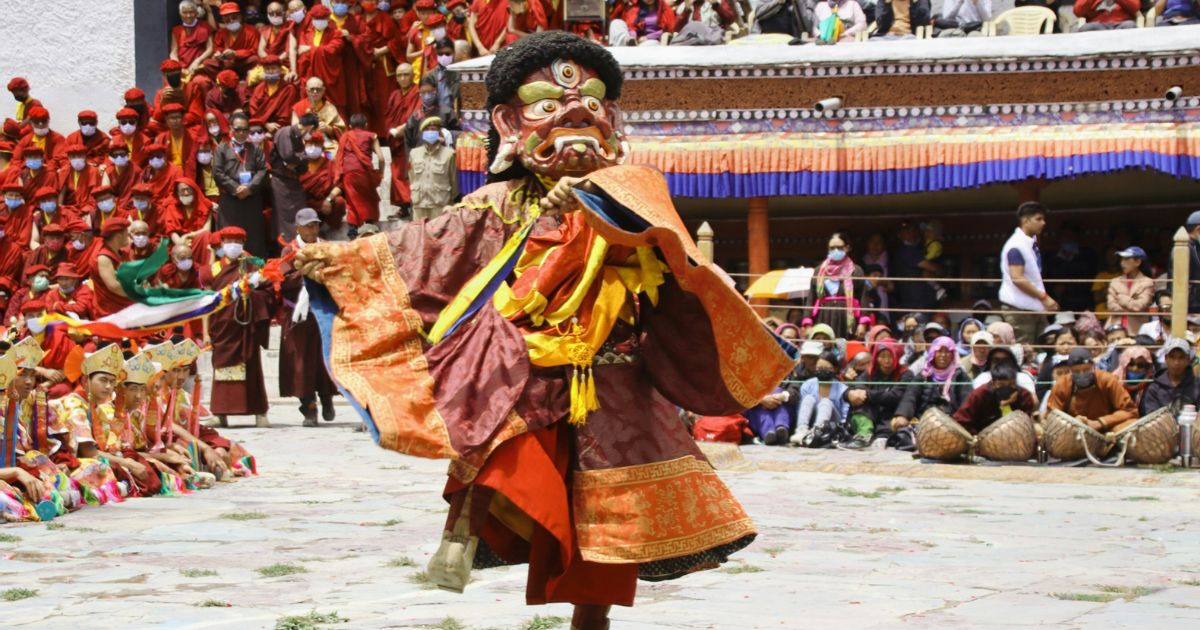
As part of the cultural entertainment, KAI TAKAMATSU performed TASHI SHOLPA, a traditional Tibetan mask dance, on all significant occasions of Tibetan culture. The performance gave the participants a taste of the performing arts and traditional culture of Tibet.
Later, Kai Takamatsu, along with his mother Reelha, sang the Tibetan folk song Kara-ri on the traditional Tibetan guitar, Danyen. The performance was a great success, and many in the audience had heard Tibetan traditional music and instruments for the first time. The musical presentation was greatly appreciated by the participants.
Tashi Yangzom, Secretary of Tibet House Japan, then conducted the dance session, helping the participants learn the Tibetan traditional dances, steps, and movements. The session was mainly dedicated to a dance, namely Gangchen Bodkyi Tenpa, and others. Participants enjoyed the dance sequence, and members of the Tibetan community helped them through the dance.
Along with the cultural exchange, they also joined in Bon Odori, a typical Japanese group dance, which is usually held during the summer Obon festival. The common experience of dance allowed participants to appreciate the cultural linkages between the two traditions.
Apart from this cultural experience, guests were also provided with traditional Tibetan butter tea, to taste the real Tibetan hospitality and tradition. The programme was a celebration of the culture of the Tibetans and Japanese people and was a joyful, laugh-filled event with friendship among the participants.