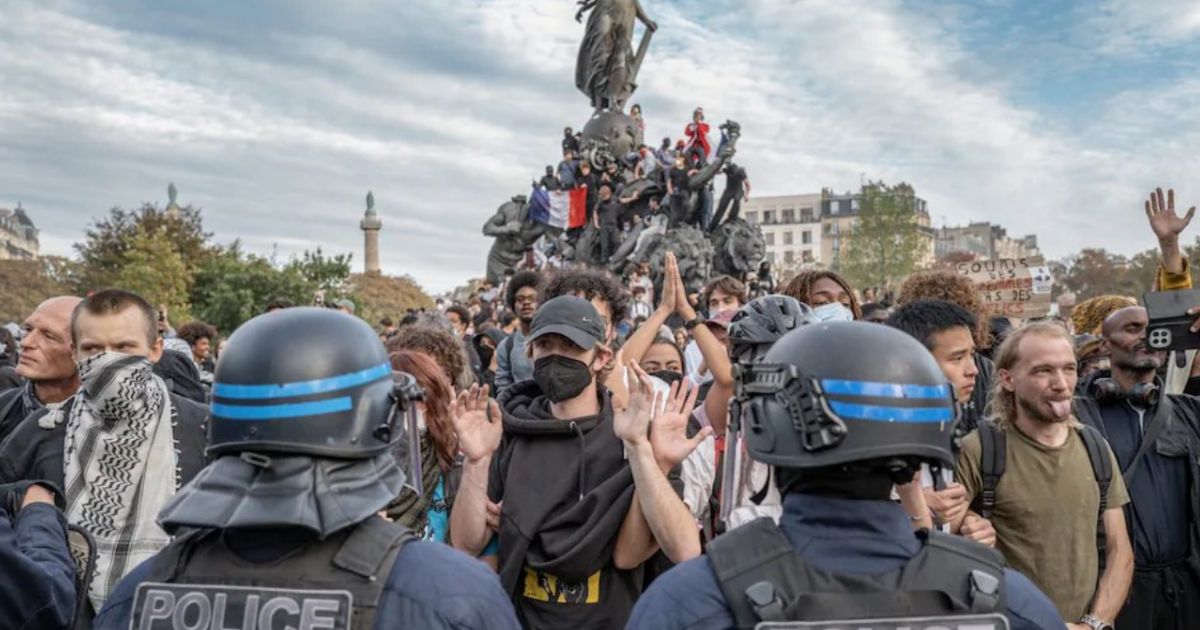
France’s eight major public sector unions called the strike to put pressure on the government before Prime Minister Sébastien Lecornu unveils the budget on 1st October, after which it will go to debate in parliament.
The unions are demanding wage increases to match inflation, and have already rejected the government’s first budgetary proposals.
Salaries frozen, again
In mid-September, Lecornu told the Le Figaro newspaper he wanted to once again freeze the index used to calculate civil servants’ base pay – a proposal that the unions called “a real provocation“.
Despite the rise in inflation, the index has remained unchanged for three years since July 2023, despite no pay rise.
On public television France 2 on Monday, CFDT general secretary Marylise Léon said that there was ‘deep anger’ among public sector workers who said to her, ‘We are fed up with civil servant-bashing’.
Who is striking?
The strike will be in full force, with teachers participating. The FSU-Snuipp primary teachers’ union said that 20 per cent of teachers, which would include 40 per cent in primary and preschool, would strike.
Public hospital unions also have appealed to workers to join, and non-emergency services and scheduled outpatient appointments may be scaled back or delayed.
All the unions in the public employment agency France Travail have, for the first time since 2018, called for workers to strike and take part in demonstrations.
Demonstrations across France
The CGT union has registered some 170 planned actions across France, the same figure as in the previous major public sector strike in December 2024.
Two marches will be converging in Paris, one from Place de la République and the other from Place d’Italie, toward Place de la Nation. One is to consist of only firefighters this summer, as these fires have been especially challenging for them.
In northern France, a march will depart Porte de Paris in Lille at 2.30 pm, a rally at the railway station in Arras at 9.30 am and at 2 pm outside the local CGT HQ in Liévin.
High school students are also protesting Tuesday in main student unions throughout France with high school blockades, joining teachers in the protest.
The USL student union president, Ryad Rani, told French news agency AFP that they felt the need to roll out the situation seen in the Île-de-France region over the entire country because the problems concern the country as a whole.
Among the demands made by the organisation are the “general lack of resources”, “overcrowded classrooms” (occasionally as many as 32 or 35 students) and the “shortage of teachers and staff” (school nurses or student supervisors).
Transport
Transport will be little affected as SUD-Rail is the only big rail union that is seeking a strike.
Four of five regional TER trains would be running, SNCF said in a statement predicting “near-normal traffic”.
High-speed TGV and long-distance Intercités trains will run normally, and the Paris metro, buses and trams will run as normal, with some disruption on the RER and suburban lines.
On Monday evening, the French civil aviation authority (DGAC) urged airlines to cut their flights by five per cent at the nation’s largest airport, Paris Charles de Gaulle and 25 per cent at Marseille-Provence airport.
At the Paris airport, flights will be reduced from 07:00 am to 8:00 pm (0500 GMT – 1800 GMT), and from 4:00 pm to midnight at Marseille airport, curbs will be put into place.
The cuts come to “minimise disruption and ensure the safety of air operations,” it said.
The DGAC also issued a warning about potential delays at airports in the cities of Nantes, Strasbourg, Limoges, Tarbes-Lourdes and Pau, recommending travellers consult their airline for more details.