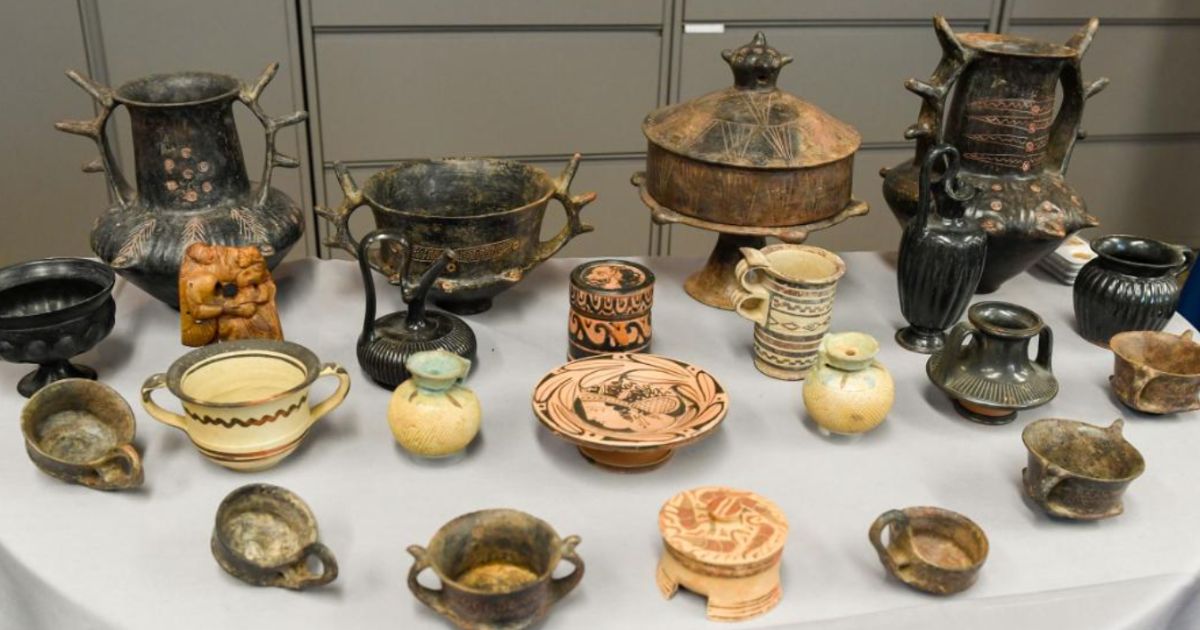
Some 337 stolen antiquities were returned to Italy by the United States on April 29, including two from the Federal Bureau of Investigation (FBI), in one of the largest returns of stolen cultural property to take place recently.
After a series of investigations, some of which were centred on New York, the artefacts, which span from the ancient Roman sculptures to Greek, Etruscan, and Egyptian pieces, were presented at the headquarters of the Carabinieri cultural protection unit in Italy.
One of the most important items revealed at the ceremony was a marble bust of Alexander the Great from the first century CE that was stolen from a Rome museum in 1960.
A bronze sculpture that was stolen from the Roman town of Herculaneum, two Egyptian basalt statues, Roman coins, jewellery, ceramics and architectural fragments between the fifth century BCE and the third century CE were also retrieved.
The FBI also released a statement on April 30 that one of the two artefacts returned in the ceremony was an ancient Roman marble epitaph that was found in a professor’s backyard in New Orleans by Tulane University in May 2025.
The second-century inscription belonged to a sailor named Sextus Congenius Verus and was previously thought to be lost in the Preservation Resource Centre of New Orleans, Italy, by Dr D. Ryan Grey.
Then the funerary stone was handed over to the FBI in New Orleans, which, in November 2025, passed it on to the FBI’s Art Crime Team.
The second artefact brought back by the FBI from Italy was picked up by the FBI in Boston, but the agency didn’t explain what it was.
Italy and the US have signed a memorandum of understanding on cultural heritage. Italy and the US have signed a memorandum of understanding on cultural heritage.
“There is no country in the world with history and culture like Italy, and there is no country willing to do anything to help restore these wonderful artefacts to your very special country than the United States,” US Ambassador to Italy Tilman J. Fertitta told reporters at the handover ceremony.
Many of the items were retrieved from clandestine excavations or robbed from cultural institutions and then passed into the international art market, Italian authorities said.
Last year, Italy and the United States signed a memorandum of understanding that harshened the already strict US import regulations for Italian archaeological items, increased information sharing and refined customs controls.
Rare artefacts are sold in the United States, where a number of auction houses, private collectors and museums bid for the pieces.
“Occasionally they are not attentive enough to the reasons for the sale of these antiques, which can be very expensive,” said an Italian Culture Ministry official who spoke to the press on condition of anonymity.
“In the future, I think we will continue to have more returns, because we know what is missing and we’re getting much better at finding it,” she added.