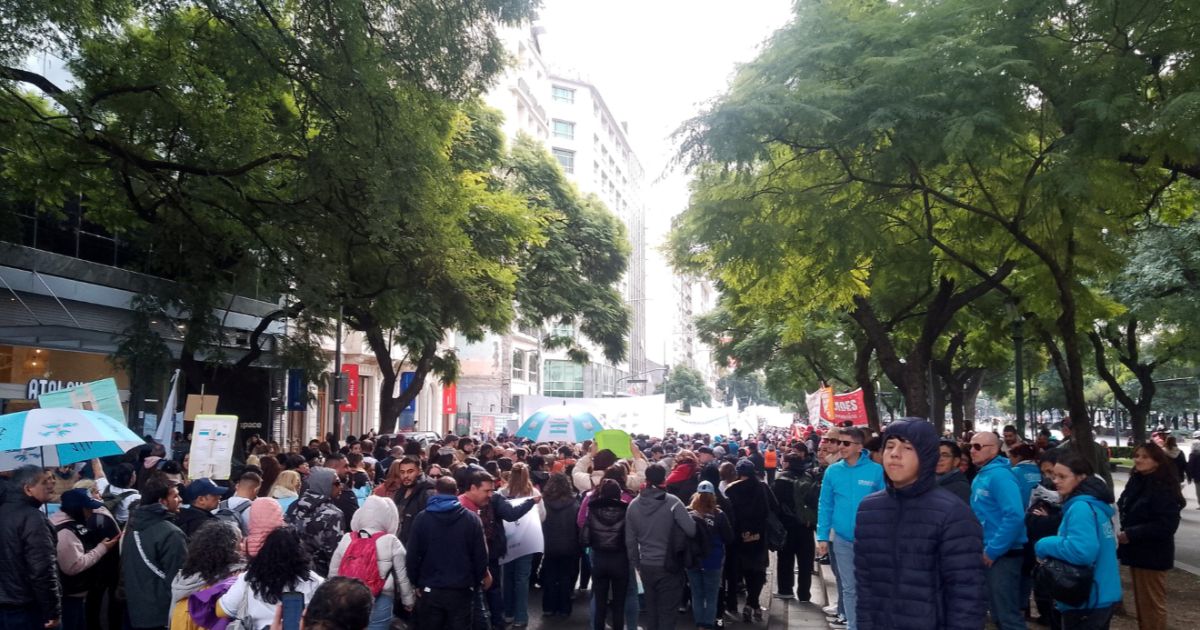
Protestors gathered in numbers in cities around Argentina, including the capital Buenos Aires, Cordoba, Mendoza and Tucuman, on 12th May.
Protestors demanded that the government of libertarian President Javier Milei enact a university funding law, at the heart of a long-standing political impasse.
The march ended in Plaza de Mayo, home to the presidential palace, in Buenos Aires and spread onto the surrounding streets.
Organisers estimated that some 600,000 students, university staff, union members and opposition supporters attended the protest in the capital, with 1.5 million taking part countrywide.
At the march, 24-year-old law student Sol Muniz, of the University of Buenos Aires, told the AP that “it’s very clear this government is determined to defund public education.”
“We are proud of the university, and that’s our greatest asset.”
18-year-old literature student Renata Lopez told AFP news agency, “I am here to defend public education.” She held a copy of Ray Bradbury’s Fahrenheit 451, a novel that depicts a future dystopian society that has outlawed books.
The novel “speaks to our current reality,” Lopez said. Defunding education isn’t unusual; it isn’t dystopian, it’s what’s going on.
What is the issue with funding the universities in Argentina?
In order to cover the costs of public universities and increase teachers’ salaries due to high inflation rates, Congress passed two laws in 2024 and 2025.
Later, Milei vetoed the law, saying it was in conflict with his government’s fiscal policy.
The parliament went ahead and reversed Milei’s veto, but his government has yet to enact the legislation.
Milei’s administration is trying to repeal the law by claiming it doesn’t include a way for the state to provide the required funding increases, given the fiscal conservative stance of its government.
There is a possibility that the case will be referred to the Supreme Court.
Like President Trump of the United States, the Argentinian president has been a harsh critic of university campuses, which he considers to be “woke” indoctrination centres.
The university suffered budget cuts under Milei
Since 2023, when Milei took office, public university budgets have been cut 40%.
They decreased from just over 0.7% of GDP in 2023 to slightly above 0.4% this year, according to a report from the Argentinian-based Ibero-American Centre for Research in Science, Technology and Innovation (or CIICTI).
This is the lowest since 1989.
Pay of university professors has dropped by about 33% in real terms, the main teachers’ union says.
The low compensation has made it more expensive for at least 580 research professors in the engineering and science departments to leave the public system for private universities, or other positions that pay more, the rector of the University of Buenos Aires, Ricardo Gelpi, said.
Argentina is proud of its University for everyone
Argentina has approximately 60 public universities that have not charged tuition since they were established in 1949.
This absence of tuition fees puts universities entirely on the government’s back: they receive about 80% to 90% of their funds from the government, says higher education policy professor Marcelo Rabossi from the University of Torcuato Di Tella in Buenos Aires.
Late last year, Rabossi spoke to the World of Higher Education podcast, calling public universities in Argentina more than just educational institutions; they are symbols of social mobility and national pride.