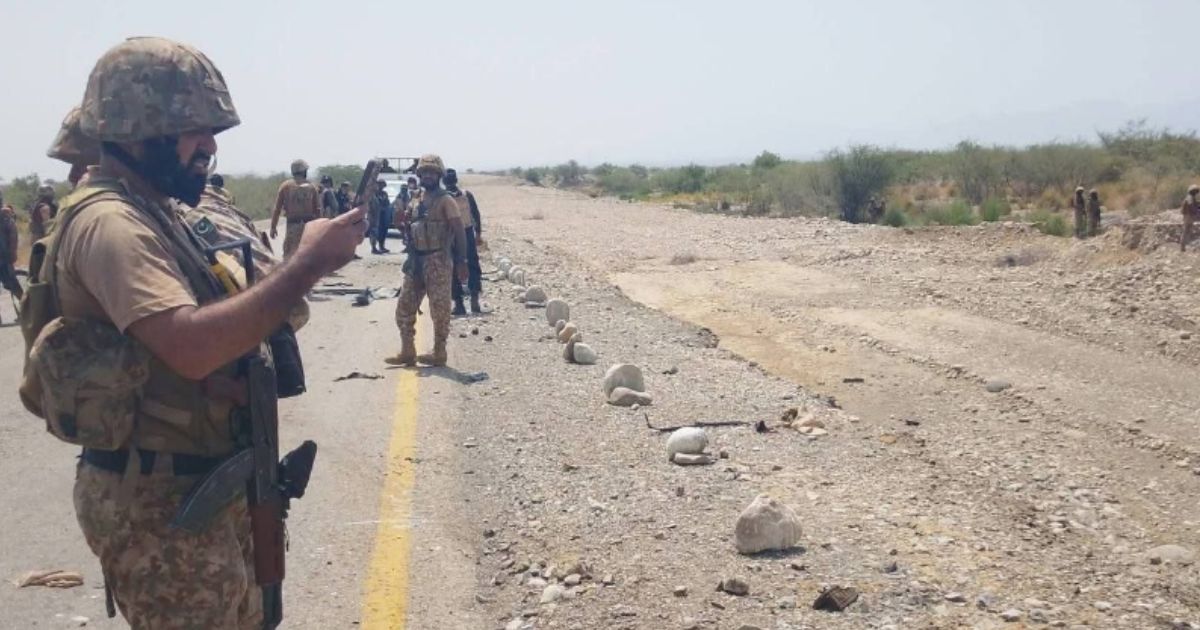
On 3rd September, the military’s media affairs wing said that 15 terrorists have been killed in security operations as they were trying to infiltrate Pakistan’s border with Afghanistan.
The terrorists had attempted to enter the North Waziristan district of the country on the night of 31st August and 1st September, said a statement issued by Inter-Services Public Relations (ISPR).
The troops, however, were spotted by the security forces and reacted “professionally and patiently”, the statement said, engaging them.
As a result of accurate and skillful engagement for 36 hours, 15 “khawarij” who were affiliated with the fitna (rebellious) group of the “Fitna-al-Khawarij” of the “India-sponsored” groups were slain, it added.
The banned Tehreek-i-Taliban Pakistan (TTP) referred to the state as Fitna al Khawarij.
During the sanitisation operation conducted after the engagement, a huge amount of weapons and ammunition were recovered from the slain terrorists, said the ISPR. The military’s media said this further “exposed the evil intentions of khawarij and their enablers who are trying to destabilise peace and stability of the country.”
It said the encounter at the Pakistan-Afghan border, on the one hand, further confirmed Pakistan’s “persistent stance on the abject failure of the Afghan Taliban regime to deny the use of Afghan soil to the terrorist organisation under their cover for cross-border terrorism” and on the other, it proved that Pakistan had not been misled by the Afghan Taliban.
The Afghan Taliban government has repeatedly failed to properly handle the borders and keep its international commitments, ISPR added.
It added that the relentless counter-terrorism campaign under the vision of Azm-i-Istehkam (as approved by the Federal Apex Committee on National Action Plan) by the security forces and law enforcement agencies of Pakistan will continue in full force to uproot the threat of foreign-sponsored and supported terrorism from the state, ISPR stated.
The Pak-Afghan border in North Waziristan was the scene of the failed infiltration attempt, which was thwarted by the security forces, to which Prime Minister Shehbaz Sharif has paid tribute in a state-run PTV report.
In a statement made by the state broadcaster, the security forces are showing “high level of professionalism, patience and courage” in putting to rest the “impure intentions” of the terrorists.
He told the media that the campaign against the menace of terrorism, Azm-i-Istehkam, would be continued with “full force and determination until the menace of terrorism is uprooted from the country”, according to the statement.
The presidency spokesman revealed that President Asif Ali Zardari also congratulated the security forces on the successful operation.
The determination of security forces to protect the borders of the dear homeland and peace and stability is laudable, the president was quoted as saying.
“There will be no tolerance of any terrorist elements operating under foreign patronage who are spreading unrest in the country”, he added.
In his celebration of the security forces’ performance, Interior Minister Mohsin Naqvi stated that the enemy’s nefarious intentions were “dusted”.
Islamabad has consistently pointed out that it has faced similar action from the security forces in the past as the Afghan Taliban impose restrictions on the use of Afghan territory by terrorist groups, especially in Pakistan.
The Foreign Office on Wednesday said that it would be hard to see any progress in relations between Pakistan and Afghanistan without tangible and credible steps being taken by the Taliban against the TTP and other terrorist groups operating from Afghan territory.
The FO spokesperson’s remarks came as China’s Special Envoy for the Urumqi process, Yue Xiaoyong, visited Islamabad to revive the Urumqi process to prevent further escalation, while Afghan ambassador Sardar Shakeb was invited to address the National Defence University.
But little can be seen in Islamabad that the Taliban have transcended the containment of the TTP activities.
As the TTP stepped up its attacks and built its network, Taliban leader Hibatullah Akhundzada had issued a warning against attacks on Pakistan, but also noted that the Taliban had moved approximately 2,000 TTP fighters and their families out of the region where they border Pakistan, according to the latest report by the UN Analytical Support and Sanctions Monitoring Team.
Relocation of the terrorists doesn’t mean that the command, training, and logistical networks are dismantled in Islamabad, which is the focus of its concerns.