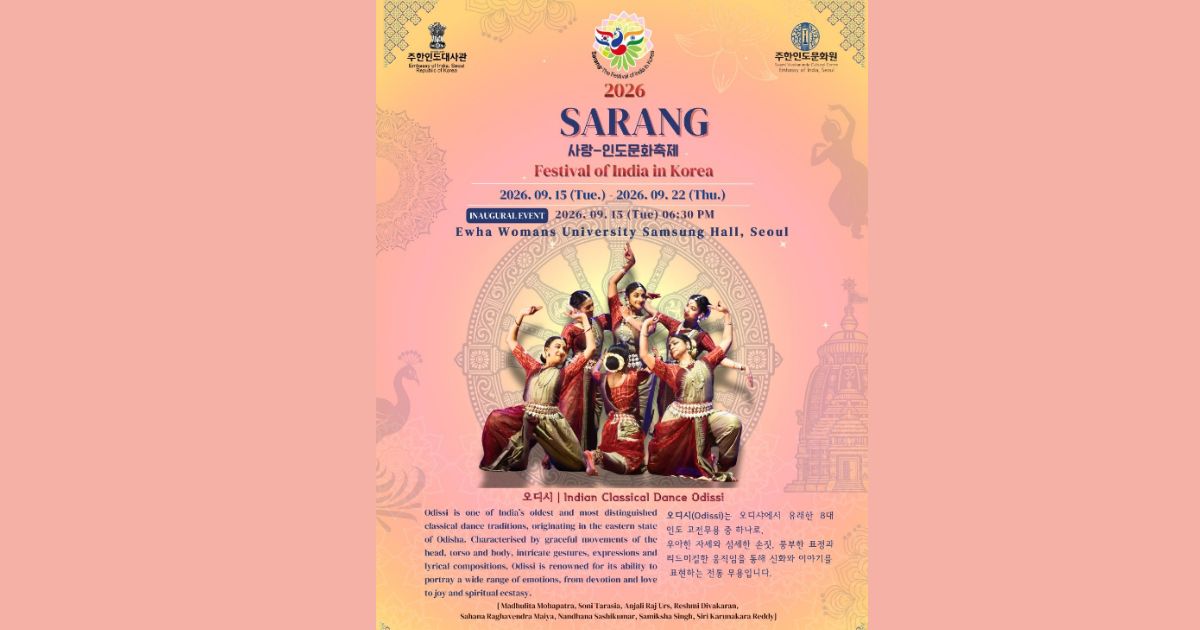
The 12th Sarang Festival will be held in September at the Embassy of India, Korea. Prestigious Indian classical dancers and filmmakers have been brought to Korea from Sept. 15- 22. The festival will also include an Odissi dance troupe that will perform in six cities this year and an Indian film program in November.
The festival starts at Samsung Hall in Ewha Womans University in Seoul and ends at the Seoul campus in Wonkwang Digital University.
Sarang started out as a small embassy event in 2015 and has expanded into a highlight of India’s cultural presentation, featuring Indian dance, music, film, art and cuisine. Sarang” signifies love in Korean and “medley of colours” in Hindi, according to the embassy.
Odissi Takes Centre Stage
The theme of this year’s festival is the classical Odissi dance style, which is renowned for its sculptural poses, rhythmic patterns, mudras and expressive facial movements, all of which are done in the state of Odisha. It is often used to play devotional songs relating to Lord Jagannath and Radha-Krishna.
Indian Ambassador to Korea Gourangalal Das stated that with India’s cultural diversity, there is scope to introduce a different tradition of classical dance in the festival every year.
The troupe was led by Madhulita Mohapatra, who has been trained at the Odisha Dance Academy and also shifted to Bengaluru in 2008. She then established the Nrityantar Academy of Performing Arts and assisted in the popularisation of Odissi in southern India. She has been awarded the Sangeet Natak Akademi’s Ustad Bismillah Khan Yuva Puraskar as well as being an empanelled artist of the Indian Council on Cultural Relations.
The troupe was eager to share Odissi and classical Indian dances with the Korean people, Mohapatra said.
The performances will also be held in Busan on Sept. 16, Gimhae on Sept. 17, Miryang on Sept. 18, and Gwangju on Sept. On Sept. 19, Nami Island and Chuncheon will be visited. 20 and 21. The troupe will then be coming back to Seoul for the final event.
There will also be workshops in conjunction with the performances (by registration via partner universities and venues).
Six Indian Films in November
The 14th Indian Film Festival will happen in November, at which Korean subtitles will be provided for six Indian films in six cities. The dates proposed are 3- 29 November, subject to confirmation.
Amongst the movies are “Queen,” “Newton,” “Manjhi – The Mountain Man”, “Dum Laga Ke Haisha”, “Sui Dhaaga” and “Sardar Udham”. The movies are about common people showing bravery in challenging situations.
Screenings are planned in Seoul, Yangsan, Gwangju, Miryang, Incheon and Busan.
The majority of the films were released between 10 and 15 years ago. They were selected in part because they are not readily available on streaming services in Korea, Das said. They will also be sure to resonate with young audiences, with a focus on family, politics, rural life and entrepreneurship.
Smaller cities were included due to the fact that the festival was created for cultural rather than mass appeal, he said. Miryang is also known as Korea’s yoga town, and was therefore an ideal setting for the program.
India-Korea Ties Gain Momentum
The festival is held during a dynamic era of India-Korea relations. During South Korean President Lee Jae Myung’s state visit to India in April, there were 25 outcomes, such as cooperation with cultural and creative industries and a cultural exchange program until 2030.
In May, Minister of Defence Rajnath Singh visited Seoul, followed by External Affairs Minister S. Jaishankar in June. They are also in talks to upgrade their Korea-India Comprehensive Economic Partnership Agreement.
Cooperation is being planned in new areas such as economic security, steel, artificial intelligence, semiconductors and space. The countries are also finalising a pilot on payment system integration which will enable Indian travellers to use UPI in Korea and Korean visitors to use their payment systems in India.
Focus on People-to-People Links
Das noted that increased people-to-people contact is still an area of opportunity. India has a number of students migrating overseas each year, but only a small number here are studying in Korea. He also pointed out the lack of skilled Indian labour and the difficulties faced by Korean workers who invite their families to join them in Korea.
Preparation work has started for a potential Korean President’s visit to India in 2028, featuring areas such as cultural exhibits, performances and archaeology.
India is also making preparations to lend approximately 200 artefacts to the planned museum, which will also serve as the venue for the wedding of the traditional legend of Queen Heo Hwang-ok, who is said to have come from India more than two thousand years ago to marry King Suro of Geumgwan Gaya.
The Sarang festival brings into the spotlight one of the oldest of India and Korea’s historical associations, but in a contemporary cultural light.