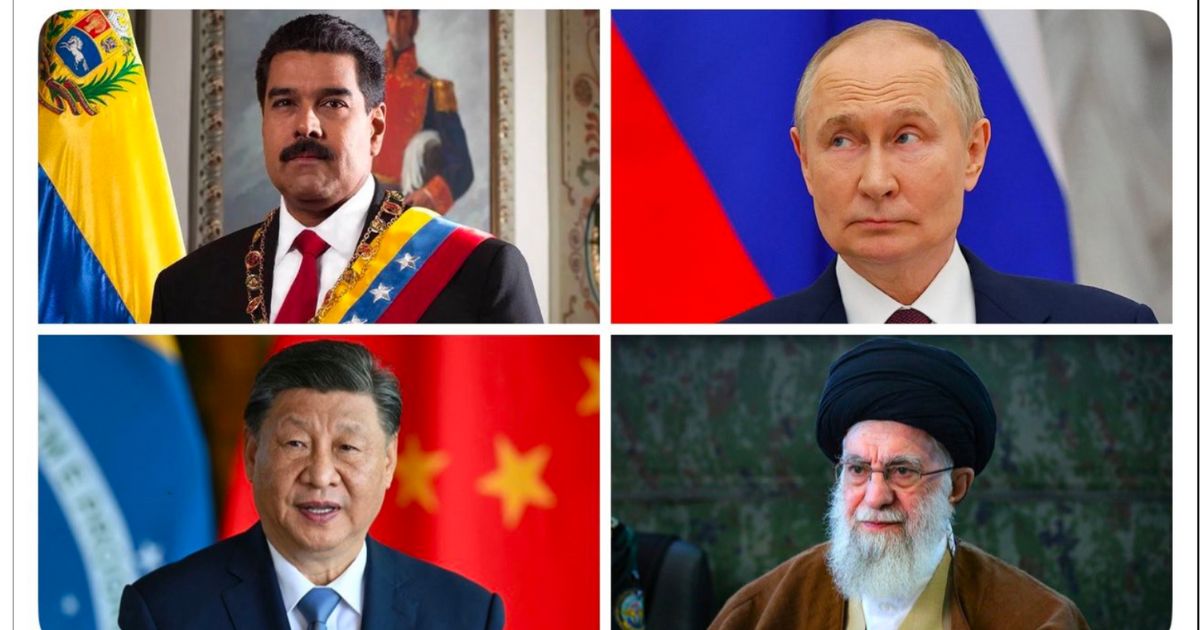
As the United States applies more military pressure on the Caribbean, Venezuelan President Nicolas Maduro desperately needs military and political assistance from Russia, China, and Iran. Internal American government papers leaked by The Washington Post show that Maduro has approached these partners regarding hi-tech defense systems, airplane repairs, and perhaps even missiles to bolster the crumbling army in Venezuela. In his outreach, the growing isolation of Venezuela is emphasized as well as its dependency on a few international partners to respond to what it views as aggression by the U.S. Although Russia is the best ally of Caracas, its ability to counter is reduced because of the current war in Ukraine.
The Plea of Military Assistance by Maduro
In a letter to Russian President Vladimir Putin, which was delivered by Venezuela Transport Minister Ramón Celestino Velasquez on a visit to Russia in October, Maduro made his request to the Russians. He asked for assistance in the restoration of Sukhoi Su-30MK2 fighter jets of Venezuela, maintenance of radars, and the acquisition of new missile armaments. A three-year finance proposal was also requested in the letter with the help of the defense conglomerate of Russia, Rostec. It is said that a second letter was sent to a Russian Deputy Prime Minister, Denis Manturov, but again, it remains unclear whether a reply was received or not.
Meanwhile, Maduro addressed the Chinese President Xi Jinping, requesting increased military collaboration and speeding up the supply of radar detection equipment. In the meantime, the Venezuelan leaders liaised with Iran to acquire drones capable of reaching 1,000 km, GPS jammers, and passive detection systems. The documents show that Maduro presented the actions of the U.S. as aggression not just to Venezuela but also to China due to their common ideological orientation.
In spite of these, all three countries have not officially confirmed their response. Nevertheless, Russia still displays figurative support. The U.S had earlier sanctioned the sale of arms to Russia by a Russian Il-76 military transport aircraft, which recently landed in Caracas after flying a route over Africa to avoid Western airspace. The Foreign Ministry of Moscow reiterated its support of the so-called national sovereignty of Venezuela and promised to act on the requests of its partners in case of emerging threats.
Role and Strategic Interests of Russia
The main ally of Maduro is still Russia, which is bound to Venezuela by the years of political and economic collaboration that Hugo Chavez introduced in the early 2000s. Oil, defense, and energy are the areas that are closely intertwined between the two countries. They recently opened a Kalashnikov munitions factory in Aragua, close to 20 years after it had been initially announced. Russia has also got lucrative exploration rights in the offshore gas fields of Patao and Mejillones in Venezuela, as well as untapped billions of crude reserves.
Nevertheless, analysts do not reckon that Russia is excited to be involved in Venezuela. Diluted by the Western sanctions and the conflict in Ukraine, Moscow has moved to other Latin American allies, especially in the case of Nicaragua, where the country has intelligence relations. Douglas Farah, the president of the IBI Consultants, said that Russia has remained rather silent on Venezuela. They have wasted minimal political goodwill in his defence of Maduro.
According to former U.S. ambassador to Venezuela James Story, the U.S. military presence in the Caribbean, such as the USS Gerald Ford, which is the largest aircraft carrier ever owned by America, has a beneficial effect on Russia indirectly. The new focus on the Western Hemisphere splits our attention on Ukraine. And that is a plus on Putin, he said.
The Weakening Military Potential of Venezuela
Russian weaponry costing billions has become obsolete or useless to Venezuela due to a 20-year investment. Estimates of former Venezuelan military officials indicate that there are fewer than five Russian-manufactured Sukhoi jets in service. Most of the tanks, helicopters, and missiles in the country are outdated. One ex-officer said Chavez purchased or sold pure junk to Venezuela.
Nevertheless, Maduro has maintained that Venezuela is well-armed and has boasted of 5,000 Igla-S surface-to-air missiles of Russian origin nationwide. Analysts, nonetheless, determine the question of the operational reliability of these weapons.
Geopolitics and Economic Interests
Venezuela is an important partner to Moscow due to its strategic location and reserves of energy. The Russian state companies have interests in joint ventures that yield more than 100,000 barrels of crude oil daily, approximately 11 percent of the total output of Venezuela, which earns it about 67 million a month, as pointed out by Francisco Monaldi of Rice University.
However, Russia finds itself in a dilemma as the Venezuelan crude competes with the Russian oil in the world market, both aiming at the same market, namely China, as a result of Western sanctions. The Russians are no longer investing in Venezuela. That is all, said Monaldi.
There would be a significant loss to Moscow in the event of a regime change in Venezuela, undermining one of the few allies in the Western Hemisphere, and losing Cuba, with its intelligence and economic relationship to Caracas being so strong. Nevertheless, analysts indicate that the new strategic agreement between Russia and Venezuela does not have any tangible military obligations, but only requests the tightening of military co-operation.
Prognosis: Weak Support, Increasing Tensions
Although Russia, China, and Iran are carrying out token shows of support, they seem to have little or no capability or desire to supply major military support. The resources of Russia are occupied in Ukraine; China is afraid of a direct clash with the U.S.; Iran is ready to provide drones and equipment, but also suffers certain limitations on an international level.
The diplomacy of Maduro is a sign of desperation as the U.S. naval operations are becoming more intense. More than a dozen U.S. strikes on alleged drug dealers in Venezuelan waters have allegedly claimed more than 60 lives since September, which Washington has clearly presented as a part of anti-narcotics missions, and Caracas has labeled as acts of aggression.
Because of the tension, it is clear that Venezuela is dependent on its dwindling circle of friends, which demonstrates how weak its status is. To date, the Maduro government is torn between sovereignty and playing chess with the world superpowers, with their interests carefully considered.