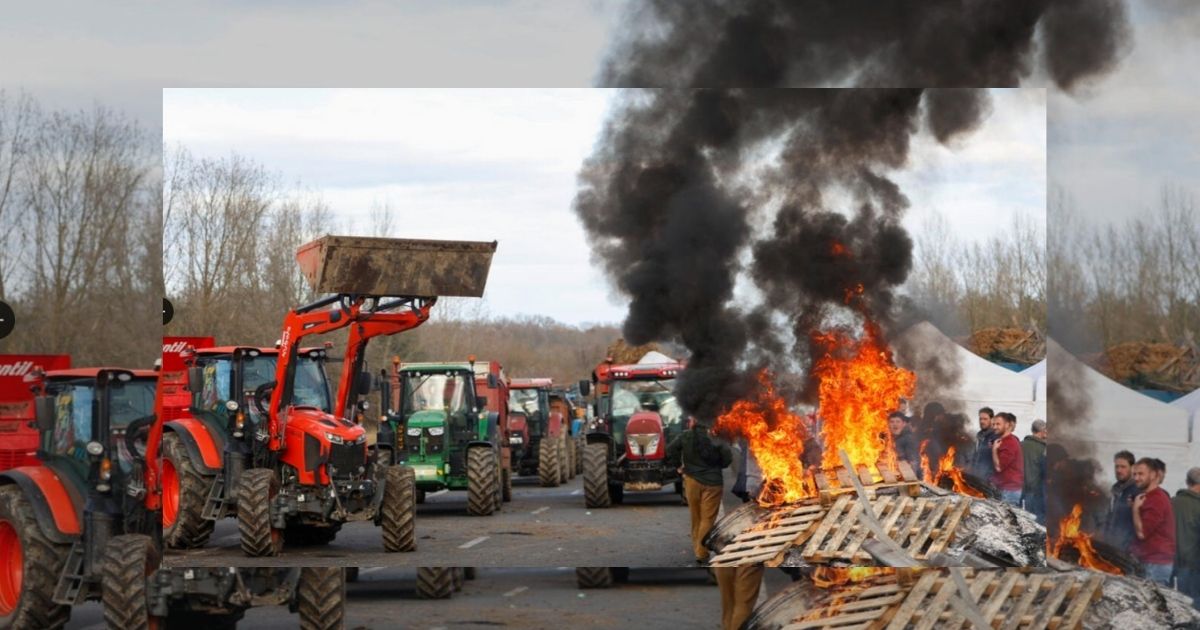
On 6th January, thousands of farmers throughout Ireland came to the town of Athlone to take part in a rolling tractor protest and hold a large national protest against the planned EU-Mercosur trade agreement. One of the largest rural mobilisations in years, the protest was marked by long processions of tractors lining the N6 motorway, followed by a rally and speeches by farmers and political representatives at the Technological University of the Shannon.
Independent Ireland had organised the demonstration, which was widely supported politically, with Sinn Féin as well as Aontu and some Independent TDs and Senators joining the farmers on the ground. The disruption of traffic by Gardaí had been announced beforehand, and it was reported that most parts of the region experienced delays as the protest continued.
That rally was only a day after the EU members granted a tentative approval of the trade agreement with Mercosur nations- Brazil, Argentina, Paraguay, and Uruguay. Although the deal has overcome a number of major hurdles, it has to be passed through the European Parliament in order to come into effect. The people of Ireland voted against the agreement, not in its present form, as senior members of the Cabinet insisted that the negotiations had not ended yet and that the Irish interests were not fully addressed.
At the centre of the resistance is intense panic amongst beef farmers, who believe that more imports of cheaper South American beef may undermine Irish farmers and endanger lives. According to the farmers, Brazilian beef might not be able to meet the same standards of environmental, animal welfare, and traceability as Irish producers would have, which would put domestic farmers in a crippling competitive position.
Of the five countries, including Ireland, France, Austria, Hungary, and Poland, voted against the deal in a meeting held in Brussels. Twenty member states supported the vote, and Belgium did not vote, which gave the agreement a qualified majority according to EU legislation.
Minister of Agriculture Martin Heydon accepted the anger and frustration that had been voiced at the Athlone rally and said the deal was something the farmers saw as a personal attack on their livelihoods. He emphasized that Irish farmers work under some of the most rigorous environmental and food safety regulations in the world, and the question is why it is fair to open the door to imports that are produced with weaker regulations.
Mr Heydon said that the level of compliance with EU regulations has been growing among farmers each year. Now, they feel like they are being challenged to compete with food that is produced to reduce environmental impact.
The Irish Farmers Association (IFA) rejoiced when the Government voted against the deal by saying that the safeguards that are to be put in place are not good enough assurances that imported beef can be of EU standard. The magnitude of the Athlone turnout, according to IFA President Francie Gorman, was a measure of the emotion of the farmers, and that Irish MEPs needed to put the agreement on hold before it could pass through the European Parliament.
Irish representative Ciaran Mullooly, the independent member of the European Parliament, demanded unity among the representatives of Ireland, with the farming organisations in the country having a unanimous opposition. “We must say no to Mercosur, whether you are in Dun Laoghaire or Dundalk,” he said to the crowd.
There were also concerns over the future of young farmers. Macra na Feirme President Josephine O’Neill was alarmed that the deal posed a risk to the generational renewal in the agricultural sector, with the price increases, a lack of access to land, and already marginal margins. Her words were: ” If we destroy farm income, we are destroying the future of Irish agriculture.”
These fears were reflected by individual farmers. Beef farmer Pat O’Hara in Co Longford raised the issue of beef traceability and quality of Brazilian beef, and others said the price would crumble in case of the sudden increase in imports. Environmental issues were also mentioned, where farmers mentioned deforestation and the carbon footprint of transporting beef half a world away.
The farm leaders claim that the struggle is not lost despite the EU vote. They are also mounting pressure on Irish and European MEPs as farmers promise to carry on with their fight against what they term as an unjust and harmful trade deal with Europe, as the European Parliament still deliberates on the same.