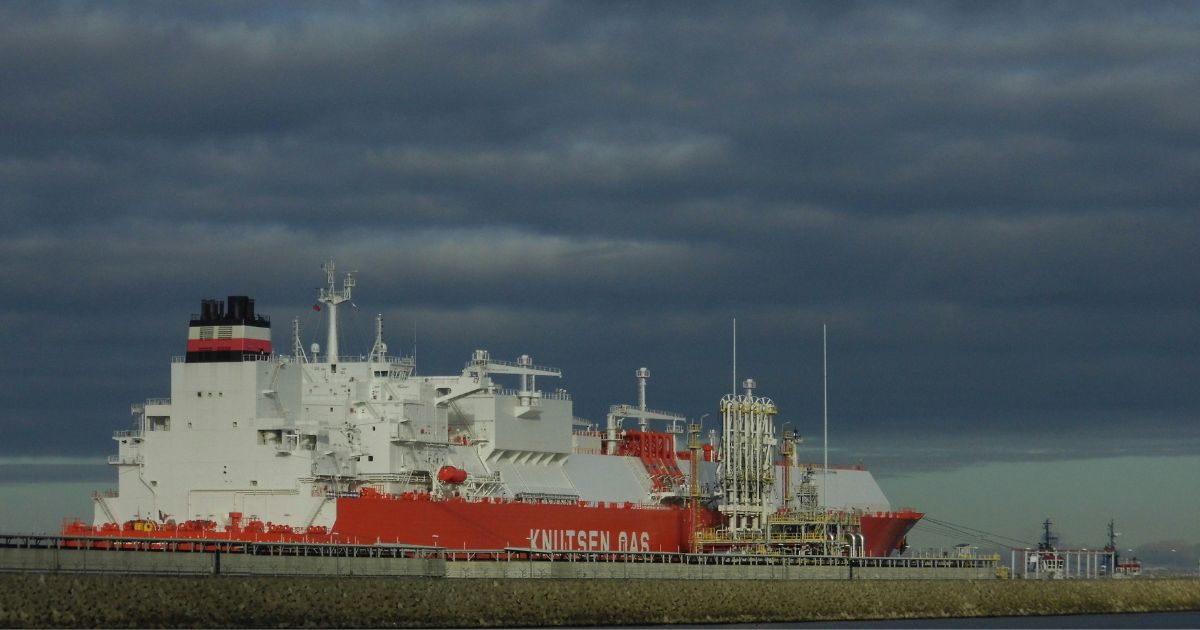
Three merchant vessels have been hit in and around the Strait of Hormuz, including a Thai-registered bulk carrier that burst into fire after departing a port in the UAE, and crew members had to evacuate the ship as a precaution.
On Wednesday, its owners reported that the Mayuree Naree was hit by “two unidentified projectiles,” and as it travelled 11 nautical miles north of Oman, the four-day hiatus of attacks in the key waterway came to an end.
An engine room fire broke out on the ship and had to be put out. The Omani navy rescued 20 of the crew but left a skeleton crew of three people to be rescued on the wrecked ship.
This is effectively the situation of the Strait, which has been closed since the start of the month following the US and Israeli assault on Iran, which led to a response by Tehran in the region. Of all the ships, few are known to have attempted to make the crossing.
The Strait carries about one-fifth of the oil and gas in the world, and in the near past, the Islamic Revolutionary Guard Corps of Iran had indicated that it would not permit even a single litre of oil to pass out of the region should the US-Israeli attacks persist.
The other two vessels that were lightly hit were. The unknown projectile struck the Japanese container ship ONE Majesty 28 miles (45km) north-west of Ras Al Khaimah in the UAE, causing slight damage above the waterline.
One of the bulk carriers, the Star Gwyneth, flagged Marshall Islands, was hit some 30 miles (50km) north-west of Dubai, on the west side of the strait, and it was at anchor when the hull was damaged in the hold. There were no severe injuries among the crew in either instance.
“Get ready,” Ebrahim Zolfaqari, a spokesperson of the military command in Iran, said, “the oil price is based on regional security, which you have destabilised.” Oil prices that briefly soared to close to $120 a barrel on Monday have since stabilised at approximately 90 on the hope that the war will come to an end soon.
According to US media, Iran had started laying twelve or more mines in the strait, but the French president, Emmanuel Macron, stated that he heard none of this. This would most probably be performed with the help of naval or Revolutionary Guards speed vessels or any midget submarines that survived the frequent attacks by the US.
Sidharth Kaushal, a naval analyst at the Royal United Services Institute, opined: “mining is a menace not due to the fact that the Iranians are capable of physically sealing the strait (most mine-laying ships can be hit, unless they have traffic to conceal themselves) but because it only takes a few to leave insurers with a sore back.”
On Tuesday, Donald Trump wrote on Truth Social that, “in case Iran has deployed any mines in the Hormuz Strait, and we have not received any reports of such a move, then they should be removed, IMMEDIATELY!” The US military has published unclassified video footage of attacks on mine-laying vessels less than two hours later.
According to the US military, it had destroyed 16 Iranian vessels that laid mines in the Strait of Hormuz as a wider policy of striking down the Iranian navy and its capability to intimidate other countries’ ships.
Adm Bradley Cooper, who was the commander of the US Central Command, stated that the US had targeted 5,500 Iranian targets, a 500 increment on the preceding day, and over 60 ships. The Iranian civilians were advised to avoid civilian ports, where it was reported that the military of the country was patrolling.
Conversations regarding the US Navy escorting the oil tankers through the Strait have been under consideration, but there has yet to be an emergence of a patrol operation, as the conflict has been at a high intensity. France had indicated that it would like to join a convoy when the worst fighting is over, but the UK has indicated that it feels that air protection is more relevant.
During a briefing at the defence department, the overall US general, Dan Caine, talked of the likelihood of the US Navy escorting the vessels through the strait. “That we are considering a variety of solutions there, and we will determine how to address issues as they arise, ” he said to reporters.”
On Wednesday, Trump was questioned on whether the US was planning to secure the strait, and he answered the journalists; “I think you are going to see great safety, and it will be very, very fast, but he did not elaborate.”
The narrowest distance of the strait at Hormuz is 21 miles (34km), with the width of the shipping lane being only 2 miles (3.2km) in one direction or the other. Typically, oil and gas exports by the countries surrounding the Persian Gulf must go through the Strait to the export markets in the world, except for a few options.
On Tuesday, the president and chief executive of Saudi Arabia’s oil company, Amin Nasser, announced that the tankers are bypassing the strait and that the east-west pipeline of the firm would be at full capacity by the end of this week, with 7m barrels per day of oil being pumped into the Red Sea port of Yanbu.