Thailand had on 31st December freed 18 Cambodian prisoners of war who had been detained for five months as part of a ceasefire deal between the two countries that had been fighting bitterly along the border.
The ceasefire agreement, which was signed by the two defense ministers at the border of the same location between the Chanthaburi province of Thailand and the Pailin province of Cambodia, stipulated the release.
The move to repatriate the 18 Cambodian soldiers was aimed at goodwill and confidence-building, in addition to compliance with the international humanitarian principles, the Thai Foreign Ministry said in a statement.
The Defense Ministry of Cambodia said that the release provides a conducive environment to the creation of peace, stability, and complete normalization of relations to the advantage of both states and their citizens in the near future.
The liberation of the soldiers eliminates one of the greatest hurdles to that objective, following two cycles of devastating battles in the name of rival claims of territory.
Thailand had argued that it had been permitted to detain the men under the terms of the Geneva Conventions that governed the rules of war, which provided that they could be imprisoned until a ceasefire. Thai authorities said the prisoners were not denied the visits of the International Committee of the Red Cross and other rights that were in the scope of the international humanitarian law.
Their continued detention was successfully employed by the government of Cambodia to inspire nationalistic feelings of the war against Thailand.
The statement of the Cambodian defense ministry on Wednesday indicated that the government has been firm in the pledge that it made to the families of the 18 soldiers and the Cambodian people as a whole that no soldier would be abandoned.
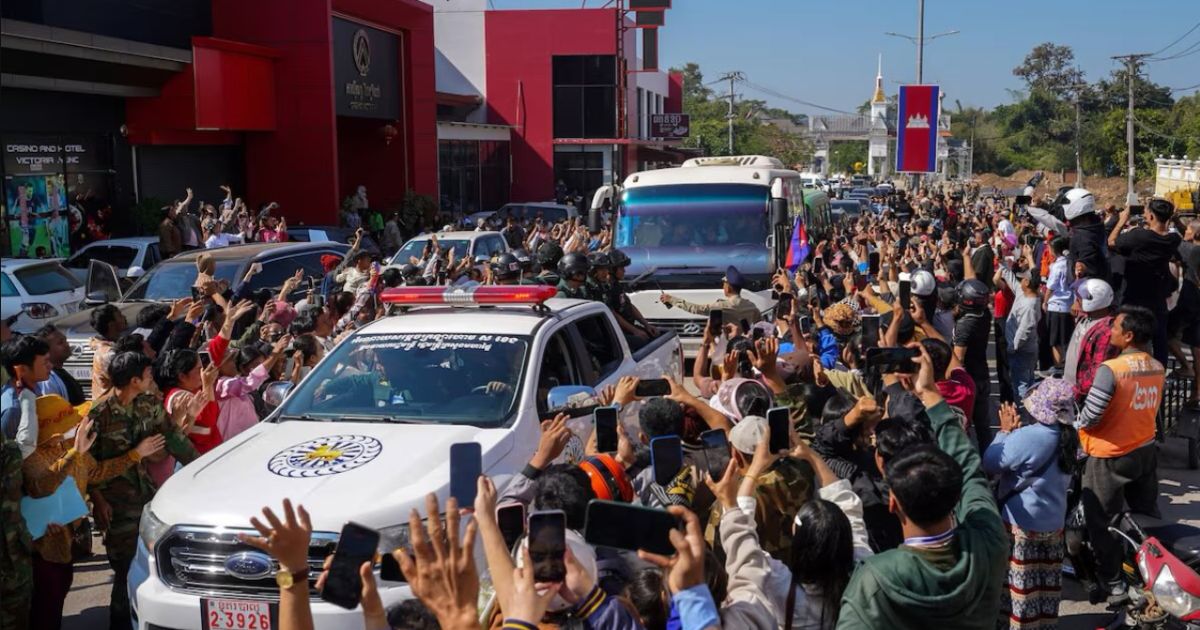
Videos circulated by the Cambodian Information Ministry depicted thousands of people along the border post to the city of Pailin celebrating and waving small flags, when a bus with the released men drove by in a motorcade. They were supposed to be flown to the capital, Phnom Penh, on Wednesday.
According to the ceasefire agreement, the soldiers would be released under the condition that the end of combat had to be maintained throughout a 72-hour period following the signing of the agreement at noon on Saturday. On Tuesday, 72 hours had passed, but the Thai government stated that it had to assess the case, saying that 250 Cambodian drones had been operational along the border.
There were varying reports of how the men had been taken captive between the two nations, and this had occurred on the same day when the first ceasefire was signed at the expiry of July.
Cambodian officials allege that their troops had friendly intentions in approaching the Thai position to offer post-fighting greetings, whereas Thai officials alleged that the Cambodians looked like they had aggressive intentions in entering what Thais regard as their territory, and then they were captured.
The number of Cambodian soldiers who were originally captured went to 20, although two of them were returned in a few days on the pretext of medical reasons.
Malaysia mediated the initial July ceasefire, and U.S. President Donald Trump, who threatened to withdraw trade privileges unless Thailand and Cambodia signed it, forced that ceasefire. It was codified further in October during a regional meeting in Malaysia, which Trump was present at.
With those deals, the nations continued with a bitter propaganda war and cross-border violence on a small scale, which intensified to large-scale heavy fighting in early December.
According to the officials, Thailand had lost 26 soldiers and one civilian as a direct result of the combat since Dec. 7. Civilian deaths were also reported in Thailand, where 44 deaths were reported.