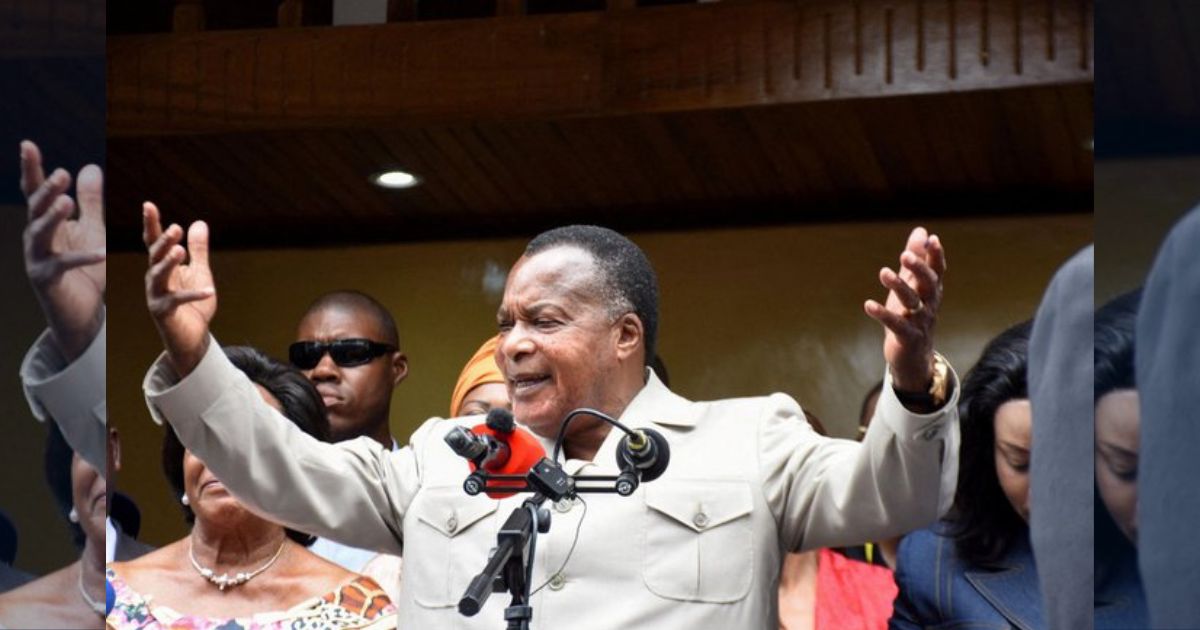
President of Congo-Brazzaville Denis Sassou Nguesso, 82, was re-elected with almost 95 per cent of the vote, according to provisional results announced on Tuesday.
The election on Sunday in the oil-rich central African nation gives Sassou Nguesso another five years on top of his 42 years in office.
Interior Minister Raymond Zephyrin Mboulou announced on national television that he had won a fifth term with “94.8 per cent” of the vote.
The turnout, which had been forecasted to be a record low, was “84.65 per cent,” he said.
The temporary results are yet to be reviewed by the constitutional court.
Since the morning of the elections in Congo-Brazzaville, the Internet has been cut.
Sunday was declared a no-traffic day, and stores were closed.
All day, the empty streets in the centre of the capital, Brazzaville, were patrolled by police and army vehicles. There were also large numbers of police outside the polling stations.
Monday saw cars back on the roads, but the internet remained down, so some frustrated citizens in Brazzaville flocked to the banks of the Congo River in an attempt to connect with the Democratic Republic of Congo, which is almost directly across the water.
Six of these candidates contested Sassou Nguesso, but the prime opposition was fragmented and by and large absent, protesting against what it declared would be a farce.
Oil and gas
The former paratrooper colonel is already the longest-serving leader in Africa, alongside Equatorial Guinea’s Teodoro Obiang Nguema Mbasogo and the Cameroonian President Paul Biya.
Although he may be said to have brought certain sanity to the nation, he is constantly accused by rights groups of persecuting opposition activists.
In his election campaign, the president emphasised his economic track record, pushing the country to modernise its infrastructure, growing the gas and agricultural sectors in an effort to make the country self-sufficient.
Most of the state revenue is oil and gas-based, and this growth is estimated at 2.9 per cent through 2025.
However, over half of the population in the country lives below the poverty line.
Those who criticise the government believe that enormous sums of state oil money have been draining out of the bank accounts of the top officials, undermining the national economy.
Several criminal complaints and investigations have already been launched against the administration of Sassou Nguesso, in particular in France.
Sassou Nguesso is certain to have been re-elected with a swapped provisional result, but according to the constitution, there will be no possibility of his being re-elected again in 2031, which leads to the possibility of a potential handover.
He informed AFP that he was not going to stay in “power permanently” and that the youths would have their time. And he would not mention anybody in particular as a probable successor.
Ruling Congo-Brazzaville since 1979 with a one-party government, Sassou Nguesso lost the first multi-party elections, whose victor he then toppled in a civil war in 1997.
In 2002, 2009, 2016 and 2021, he was re-elected in what the opposition considered to be neither transparent nor democratic votes.