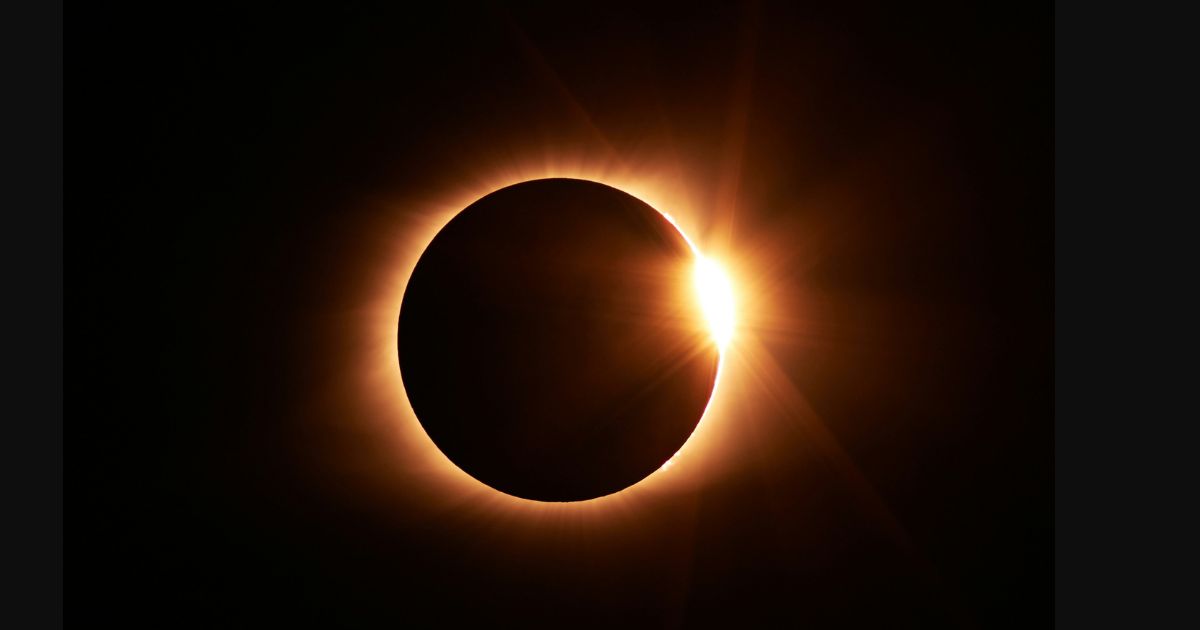
A solar eclipse on 17th February will be a “ring of fire,” the first eclipse of 2026, although only approximately 2 per cent of the population of the world will be lucky enough to look at the eclipse, according to Time and Date.
“It is also known as an annular solar eclipse and it happens when the moon comes between the Earth and the sun and it is too distant during its orbit to totally cover the disk of the sun,” Dr. C. Alex Young, the associate director of science communication in the Heliophysics Science Division of NASA in Goddard Space Flight Center in Greenbelt, Maryland, said in an email.
Surya Grahan 2026: The first solar eclipse of 2026 is about to take place on February 17th in the Aquarius zodiac sign and Dhanishtha Nakshatra. This will be a Ring of Fire Eclipse. During the eclipse, the sun will appear like a shining bracelet. Astronomers predict that the moon… pic.twitter.com/5KWqNtjaZK
— The Daily Jagran (@TheDailyJagran) February 17, 2026
“This leaves a halo of sunshine around the black outline of the moon,” which he described, hence the name of the phenomenon, the ring of fire. In case the sun is thoroughly covered by the moon, it turns into a total eclipse. According to NASA, a partial solar eclipse occurs when the sun, moon and Earth are not in a perfect position, with the sun travelling between the sun and the Earth.
The ring of fire will be seen best on a strip across Antarctica, with a partial eclipse seen on the remainder of the polar ice continent, some parts of Africa and South America.
Solar eclipses in the form of annular eclipses occur once or twice a year, but most of them cannot be seen in most regions throughout the world. NASA believes that there will be another annular eclipse on February 6, 2027, and it will be seen in greater regions of South America and Africa. Young says that the next chance of witnessing an annular eclipse will be in 2039 for people in the United States.
There are two eclipses and sometimes three. According to astronomers, they are known as eclipse seasons, and Young observed that a solar eclipse is always followed by a lunar eclipse two weeks ahead or behind. This eclipse is the first of the season, and a total lunar eclipse will follow on the 3rd day of March.
The new solar eclipse will be an annular one that will happen in 2024. According to EarthSky, the shadow of the moon will cut through the Earth during the event, creating a path that is 383 miles (616 kilometres) wide and 2,661 miles (4,282 kilometres) long.
Since the thinner ring of fire just covers Antarctica, it will require many individuals to be glued to livestreams to watch it. Young said they were just a question of geometry. It takes just the right place at an extremely thin line of annularity to view one, and so it is so infrequent to experience an eclipse such as this one.
According to Time and Date, the annular eclipse will be most dramatic at the Concordia Station, Antarctica, which starts at 6:48 p.m. local time (6:42 a.m. ET) and reaches its peak at 7:47 p.m. local time (7:12 a.m. ET). The program will take approximately two hours.
According to Time and Date, a partial eclipse will be seen in South Africa, South America and Antarctica.
The partial eclipse will be visible in Argentina and Chile as early as 7 a.m. local time (5 a.m. ET). In southern Africa, sky gazers can witness the partial eclipse during early to midafternoon.