An official media outlet reported on 25th March a full-process demonstration of China’s Atlas drone swarm operations system. An expert in military affairs said in a report by the Global Times that “the system not only represents a growing scope of application in battlefields for drone swarm operations, but also represents a rapid progress in drone swarm operations based on algorithms, which is revolutionising modern warfare by introducing autonomous coordination and combat capabilities.”
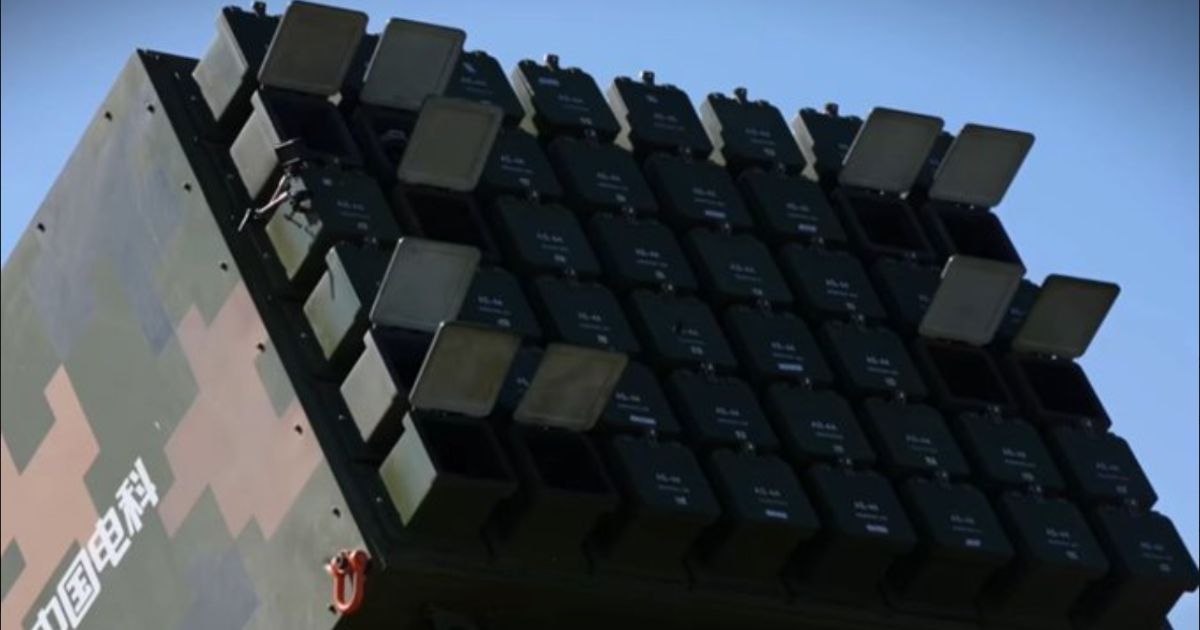
The system includes a Swarm-2 ground combat vehicle, a command vehicle, and a support vehicle, CCTV News military channel reported on Wednesday. The launch vehicle has a logo of a Chinese technology firm, China Electronics Technology Group Corp., footage showed.
The Swarm-2 Ground Combat Vehicle was introduced to the world during the Airshow China 2024 exhibition, which took place in the southern part of South China’s Guangdong Province. The Swarm-2 Ground Combat Vehicle is capable of carrying 48 fixed-wing drones, while the command vehicle is capable of controlling 96 drones simultaneously. The drones are capable of carrying different payloads, such as the electro-optical reconnaissance payload, the strike payload, and the relay payload, among others. The drones can also be used in different combinations to create multifunctional swarms, as was previously reported by CCTV News.
According to the latest report on Wednesday, at the test site, three targets similar in appearance were set up in the strike zone, and the Atlas swarm system for the operation of the drones carried out the task efficiently, including reconnaissance, identification of the command vehicle, opening the launcher, and launching the drones.
On the other hand, the Swarm-2 vehicle used a method where drones were launched at intervals of three seconds, with one drone being launched every three seconds.
Furthermore, the types and sequence of launching drones can be flexibly designed based on requirements. Reconnaissance drones can be launched ahead of time for reconnaissance purposes, followed by drones used for electronic warfare and then attack drones to counter opponents, said the report.
Equipped with swarm intelligence technology, nearly 100 high-speed drones can make dense and accurate formations in a short time during mission implementation. They can also adapt themselves automatically to various environmental influences, such as air flow disturbance, and avoid collisions in mid-air, CCTV News reported.
The swarm control algorithms of the system enable each drone to have a “smart brain”, allowing communication and sharing of information and real-time positional adjustments in maintaining swarm formations, as reported by CCTV News.
The report said that a swarm of this magnitude can be controlled by a single operator, allowing up to 96 drones in flight, likening it to a person flying almost 100 kites in flight with a single line.
The system has drones of different sizes as part of its swarm technology, allowing complementary capabilities.
Wang Yunfei, a Chinese military affairs expert, said in a report by Global Times on Wednesday that the system has great potential in expanding battlefield applications as it showed a modular task configuration.
First, in saturation attack operations against the air defence systems of the enemy, the deployment of a large number of drones in multiple waves in various directions is possible, which will make it difficult for the enemy to effectively respond to the attack, according to Wang.
Second, in precision strike operations, unlike traditional long-range weaponry whose accuracy is often subject to various environmental influences such as weather and electronic interference, drones are capable of lingering over the position of the enemy, which makes surveillance possible, hence enabling strikes at close range with high accuracy, according to the expert.
Third, in deep strike operations, drones with the capability to strike within hundreds or even thousands of kilometres are capable of striking at low altitude with low speed and small radar cross-sections, which makes the distinction between the front line and the depth areas difficult, according to Wang.
From a technological perspective, according to this expert, these capabilities are enabled by China’s advances in artificial intelligence and large models.
On a complex battlefield, drones are needed to carry out complex tasks, such as recognising targets, allocating tasks, and planning routes, which are difficult or inefficient to carry out through human control. However, with artificial intelligence pre-training and algorithms, drones are capable of carrying out these tasks on their own, and in some cases, they are capable of adapting to changing battlefield conditions, according to Wang.