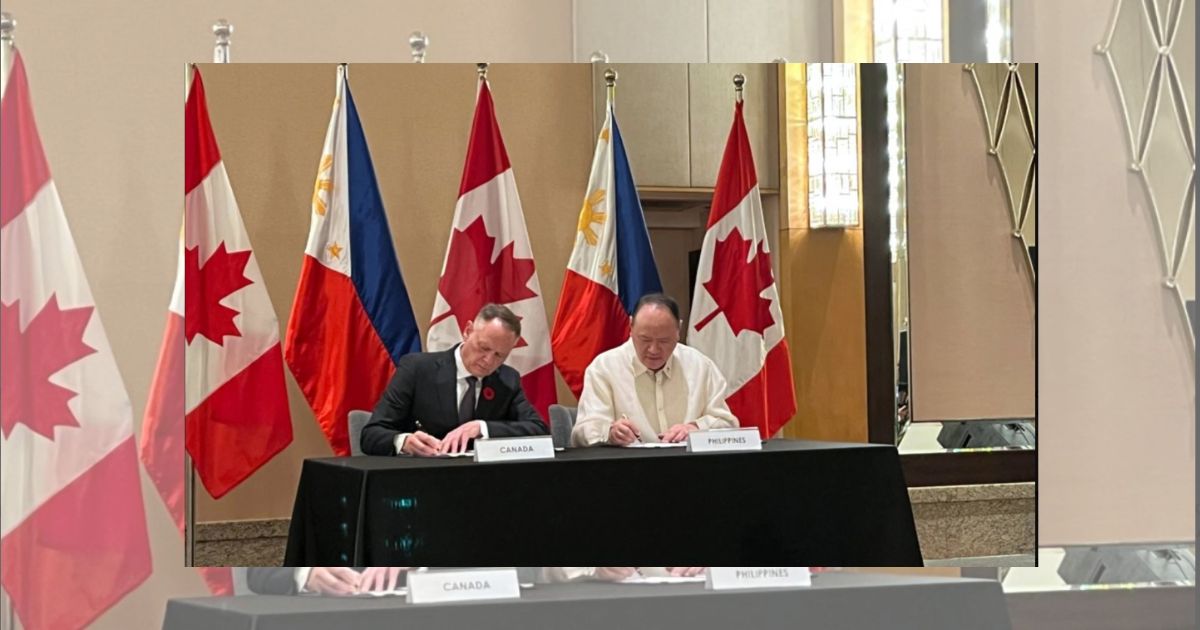
To reinforce countermeasures against aggression, the major defense agreement between Canada and the Philippines was signed on 2nd November, officials said, which is the main antagonist of China’s increasingly aggressive and coercive activities in the South China Sea.
Other Western countries, such as Canada, have been enhancing their military presence in the Indo-Pacific to facilitate the rule of law and increase trading and investment in the region. The plan coincides with the attempts of President Ferdinand Marcos Jr. to establish defense relationships with other nations in order to make the underfunded military confront militarily superior China in the contentious waters.
China did not respond immediately, with the country asserting that the Philippines is a “troublemaker” and a saboteur of regional peace and security after practicing joint patrols and combat exercises with the United States of America and other nations in the South China Sea.
Beijing has asserted ownership of the waterway, a key trade route, virtually in every bit, although an arbitration ruling in 2016 said the claims were invalid under a 1982 U.N. convention.
China has rejected the decision and has resorted to using strong water cannons and threatening blocking tactics against the Philippine coast guard and other ships, which have led to collisions and injuries to the crews. Territorial quarrels between Vietnam, Malaysia, Brunei, and Taiwan have been active too.
After a closed-door meeting in Manila, Philippine Defense Secretary Gilberto Teodoro Jr. on Sunday signed the Status of Visiting Forces Agreement with his Canadian counterpart David McGuinty.
According to McGuinty, the agreement will enhance combined military training, the exchange of information, and collaboration in solving emergencies, including responding to natural disasters.
According to Teodoro, the agreement will be fundamental towards the creation of a rules-based international order in a region that is under the threat of aggression by China.
“Who is hegemonic? Who desires to increase its borders in the world? China,” Teodoro said.
Such agreements offer a legal basis for visits of foreign troops in either country to engage in large-scale exercises.
In the case of the Philippines, the first defense agreement signed with the U.S. was in 1998, with another deal with Australia being signed nine years afterwards. The third and the last signed under Marcos was the agreement with Canada that preceded the same with Japan and New Zealand.
There are negotiations with France and Singapore to make such agreements. It is also striving to initiate negotiations with Britain and even Germany and India, Teodoro and other officials said.
During the Association of Southeast Asian Nations annual meeting at the defense ministers’ meeting with those of the Asian and Western countries on Saturday in Malaysia, Teodoro criticized a recent Chinese announcement to put in place a nature reserve in the Scarborough Shoal, a fruitful fishing ground that is being claimed by Manila and Beijing.
To us, Teodoro said, is a cloaked effort to exert military power and the threat of military power, to the prejudice of the rights of smaller nations and their citizens, who are dependent upon the bounty of these waters.
In September, Canada denounced the plan of China when it was announced and stated that it did not support efforts to use environmental protection as a means of annexing Scarborough Shoal. Canada in September also condemned the use of water cannons by China as a danger, and this injured one member of the Filipino government on one of the government vessels.
Canadian Ambassador to Manila, David Hartman, has indicated that his nation has been outspoken in fighting the alluring and illegal activities of China in the waters of the region and will not relent in fighting it.
Canada signed a defense co-operation agreement with the Philippines last year. In 2023, another agreement signed in Ottawa provided the Philippines with access to Canadian data of the so-called Dark Vessel Detection System, which uses satellite-based technology to locate illegal vessels even when they turn off location-transmitting devices.
The Philippine coast guard has utilized Canadian technology to monitor the Chinese coast guard and fishing vessels in the South China Sea.