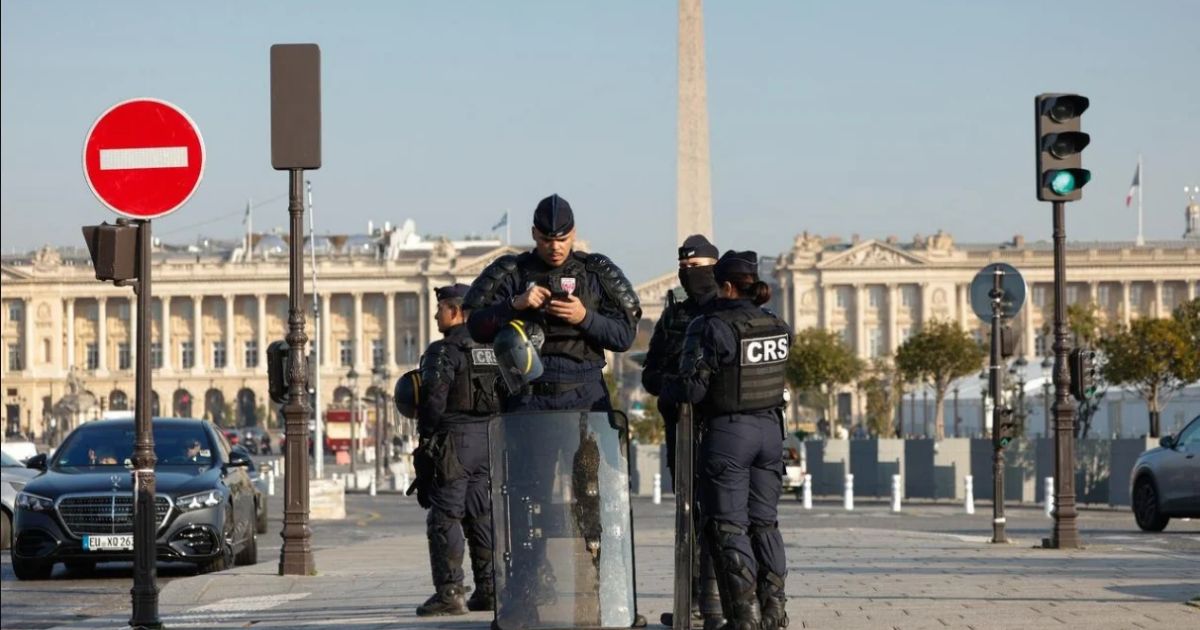
The country’s major museums shut their doors, and a large police presence was put in place to prevent last week’s violent scenes from repeating themselves during Sunday’s new protests in Paris, where authorities deployed a significant police force in the French capital.
Groups of masked people attacked businesses in Paris and other city centres, creating the impression that the government had lost control, with scenes of looting, burned-out cars and attacks on public buildings.
As many as 70,000 officers, helicopters, armoured vehicles and water cannons will be brought in across the country, Interior Minister Laurent Nuñez said.
More than half a million people took to the streets last week, and that number is expected to be repeated.
Saturday is expected to see major museums such as the Louvre, the Orsay Museum, the Picasso Museum and the Grand Palais closed. One of the world’s most prestigious contemporary art fairs, Art Basel, opened its doors to the public Friday, “but only for the day,” warned organisers, who took the decision to cancel the programme for the weekend in the face of threats of unrest.
The Parisian merchants have been sealing off stores these past few days. One of the areas with the most activity last weekend, Place de la République in Paris, had its shops and a bank’s windows boarded up with wooden panels to prevent any possible looters.
After the disturbances, the prefect of police in Paris, Patrice Faure, appealed to the City’s business owners to employ security personnel. He later explained that the Government should protect business owners and their businesses.
French shopkeepers fear new looting in upcoming protests
Last weekend saw some 3,000 shops in France damaged or looted.
Protest marches will take place in Paris and Marseille, and some others, such as in Montpellier, Nice and Lyon, have been banned by the local authorities. The unrest was severe in cities outside of Paris. In the French town of Limoges, a suspected arson fire was responsible for making it almost impossible for the 19th-century city hall to survive.
The trade unions have condemned the bans as a breach of freedom of expression, guaranteed by the constitution.
President Emmanuel Macron, a centrist, rushed into the crisis in the last years of his powerful mandate, and his popularity is now at its lowest level since his 2017 election. He said the action is to ensure the safety of city centres, businesses and public buildings.
The demonstration in the city 110 kilometres (70 miles) south of Paris will also be closely watched on Saturday.
Some 50 groups are protesting against the far right on the fringes of the two-day congress of Marine Le Pen’s nationalistic, anti-immigration party ahead of next spring’s presidential election. Organisers are trade unions, left-wing parties, student and anti-racism groups.
Last month, protests broke out in a high school in the Paris region’s east, where a shortage of teachers had been a problem.
Since then, class boycotts and demonstrations have spread in other Paris suburbs and throughout the country, even in smaller towns. High school kids have been complaining about the low funding and lack of teachers, especially in lower-income areas. A few also wanted the reform of the university system of admissions – an unfair system, in their view.
The movement has now transformed into bigger demonstrations against high living costs, as the government appears incapable of meeting students’ demands, and only months before the election to select Macron’s successor.
“Today the money is in the pockets of a handful of individuals,” art critic and art teacher Victoria Ambrosini, from Saint-Denis University, told RFA. “But it is no longer possible.”