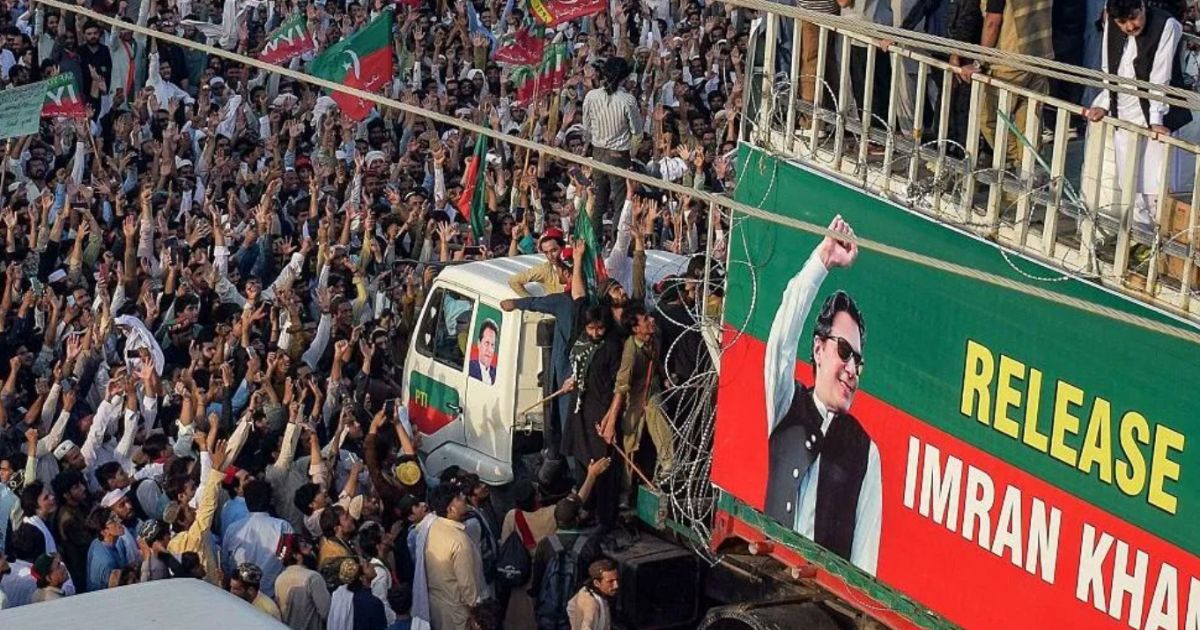
On Sept 24, the authorities in Pakistan’s capital closed major entry points to the city ahead of a protest on the weekend by supporters of jailed ex-PM Imran Khan, with double-stacked shipping containers.
Police deployed 22,000 security personnel to lock down Islamabad, officials told AFP, barring entry and exit to neighbouring Khyber Pakhtunkhwa province, which Khan’s party rules.
The highways, entry points and main intersections were blocked, effectively cutting off transport links and shutting down movement within these areas.
Traffic-jammed cars were visible, along with motorcycle riders biking in and out between containers.
On the afternoon of Sept 24, AFP journalists found the toll plaza of the Islamabad-Peshawar highway completely barricaded, which was equipped with containers and barriers along the main road.
“The motorway shut down, and this is making it difficult for the people,” said Nayhmat Khan, a 25-year-old school teacher.
“Poor people depend on everyday labour for their livelihoods, and with this inflation, life is already very hard for them,” he told AFP.
The government’s pre-emptive action in anticipation of the planned protest by Khan on Sept 27 has ratcheted up during the past few days with the arrest of Khan’s sisters, Aleema Khan, Uzma Khan and Noreen Niazi, through the Maintenance of Public Order (MPO) ordinance of the state of Punjab.
They were accused by the authorities of “mobilising supporters through social media and incitement against state institutions”, an order AFP journalists saw.
Dozens of lawmakers, regional leaders and opposition activists from Imran Khan’s Pakistan Tehreek-e-Insaf (PTI) party were also picked up in several districts of Punjab province, as well as Islamabad, the party’s strongholds.
PTI’s information secretary, Mr Sheikh Waqas Akram, said that the party’s “almost 1,500” activists were detained.
The political deadlock has been accompanied by rising concerns about the censorship of news, mass arrests and restrictions on the freedom of expression in Pakistan, which have been reported by international human rights watchdogs on a regular basis.
“Targeting of Imran Khan’s family and PTI Party activists is a blatant violation of their rights to liberty, freedom of expression, association and peaceful assembly,” Babu Ram Pant, Amnesty International, said.
“This is a reflection of the harshness of the current bans in Pakistan.”
The 73-year-old former cricketer has been in prison since August 2023 and is accused of a multitude of charges, including corruption, treason, inciting violence, etc after the anti-establishment riots which swept the nation in May 2023.
Khan and his legal team deny the charges, calling them politically motivated in an attempt to “neutralise” his popularity.
He had been treated for the eye; his wife and attorney stated that he had lost almost all vision in his right eye.
Khan rose to power with the support of the country’s strong military establishment, but lost favour for some appointments and foreign policy decisions before soon being toppled in a parliamentary no-confidence vote in April 2022.
He has been a public critic of military chiefs, including army chief Asim Munir, for orchestrating his downfall and perpetrating a campaign of political victimisation.
The capital march is the first major street action by PTI to demand Khan’s release in months.
Attaullah Tarar, Minister for Information, denied the city was undergoing a lockdown situation.
Tarar told a press conference in Khyber Pakhtunkhwa that “they don’t have to come to Islamabad”. “No one will be allowed to shut down the city.”
The protest on skyrocketing inflation and the petrol levy, initially organised by the right-wing Jamaat-e-Islami party and the farmers’ union leaders, was postponed after a meeting with the Shehbaz Sharif government, in which the party walked alone.