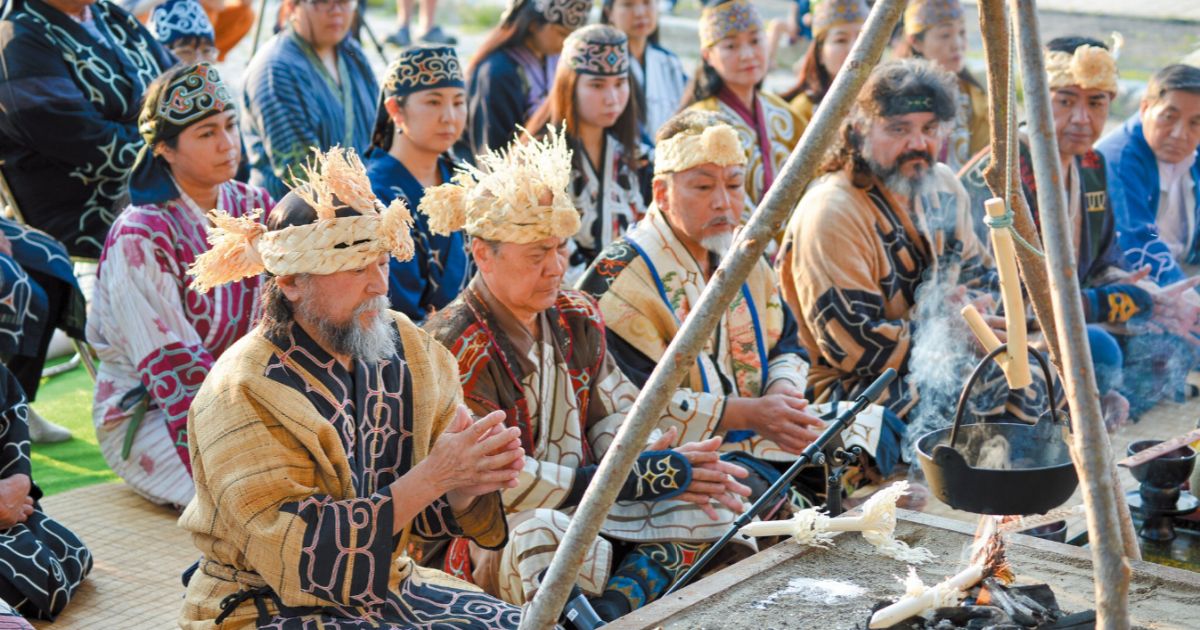
The Ainu have lived in northern parts of the Japanese archipelago, especially Hokkaido, since ancient times. It is believed that humans first arrived in Hokkaido about 30,000 years ago and the distinctive Ainu lifestyle began to flourish from the 13th century. Hunting, gathering, fishing, grain cultivation and cross-sea trade were the core of their society.
Respect for nature is the central pillar of Ainu culture. According to the Ainu, everything in nature possesses ramat, or immortal spirits. Very powerful spirits are called kamuy. This spiritual bond is reflected in oral literature, traditional songs, dances and instrumental performances, and in patterns on clothing, tools and ritual objects through wood carving and embroidery.
There was friction with the wajin (ethnic Japanese), and the Meiji government enacted policies of forced assimilation between 1868 and 1912, which brought about major changes in Ainu culture. In 1997, Japan was the first country to pass a law recognising the Ainu as a distinct ethnic group and undertook steps to preserve Ainu cultural heritage.
The UN Declaration on the Rights of Indigenous Peoples was adopted in 2007, and the Diet passed a resolution recognising the Ainu as indigenous people. This has helped to bolster efforts to protect their identity and revitalise their culture. The Ainu were officially recognised as an indigenous people under the Ainu Policy Promotion Act enacted in May 2019.
Keeping Ainu History Alive
The Upopoy National Ainu Museum and Park has been established in Shiraoi, Hokkaido, as a centre for the preservation and promotion of this ancient but living culture. Upopoy is an Ainu word that means “singing together in a large group”.
The 15-hectare site is roughly a 10-minute walk from Shiraoi Station. Visitors can see Lake Poroto, seasonal gardens and the relatively mild winter climate of the area. The site includes three major facilities: National Ainu Museum, National Ainu Park and Memorial Site.
The Memorial Site houses excavated remains and burial goods of Ainu people collected by universities and research institutions. Some were said to have been gathered without the knowledge or consent of the Ainu. Memorial services are held to honour the individuals, and the items are safeguarded until they can be returned to their rightful descendants or communities.
In Upopoy, the Ainu language and identity are everywhere. Ainu, katakana and Roman characters are used for facility names, exhibit themes and programs. Staff also have Ainu nicknames called ponre, based on the custom of not using one’s real name in everyday life, for fear of bad luck.
In its permanent exhibition, Ainu culture is presented in six themes: language, universe, lives, history, work and exchange. The information is available in multiple languages, including English, Chinese and Korean. The Ainu culture is not a museum-restricted historical artefact but a living tradition told from the Ainu perspective.
Stories, Crafts and Performances
The National Ainu Park around the museum has a traditional Ainu village, called a kotan, the Crafts Studio and the Cultural Exchange Hall.
The kotan features traditional houses called cise where visitors can take singing classes and hear stories. Visitors can learn to play the mukkuri, a traditional mouth harp, and try embroidery and wood carving at the Crafts Studio. Artisans will also demonstrate skills and answer questions.
The Cultural Exchange Hall features Ainu performing arts such as traditional dances designated as an intangible cultural heritage by UNESCO, heroic epic poetry called yukar, and mukkuri performances. Traditional costumes with detailed embroidery and appliqué enhance the experience. Depending on the program, the audio guide and printed material are available in English, Chinese, Thai, Korean and Russian.
Nearby Archery Space provides visitors with the opportunity to try Ainu archery. Three shots with blunt-tipped arrows are free, and six shots with pointed arrows at animal-shaped targets are ¥500.
Traditional Ainu archery-based hunting methods ceased to be used in the late 1870s, after the government banned poison arrows and bow traps. But archery is still an important part of Ainu heritage, and shows their belief that animals can be manifestations of kamuy and should be treated with respect and gratitude.
In the Workshop area, you can learn to make simple Ainu dishes, and cafes and restaurants serve traditional cuisine. Museum shops sell Ainu patterned textiles, woodwork, books and Hokkaido souvenirs.
Getting to Upopoy is easy too, with a 15-minute express train ride from Tomakomai Station or a 40-minute ride from New Chitose Airport near Sapporo.
Upopoy is slated to have a booth at Tourism Expo Japan 2026 at Tokyo Big Sight from Sept. 24 to 27. Visitors can experience traditional Ainu crafts, wear authentic costumes and enjoy live performances of traditional dance and mukkuri music