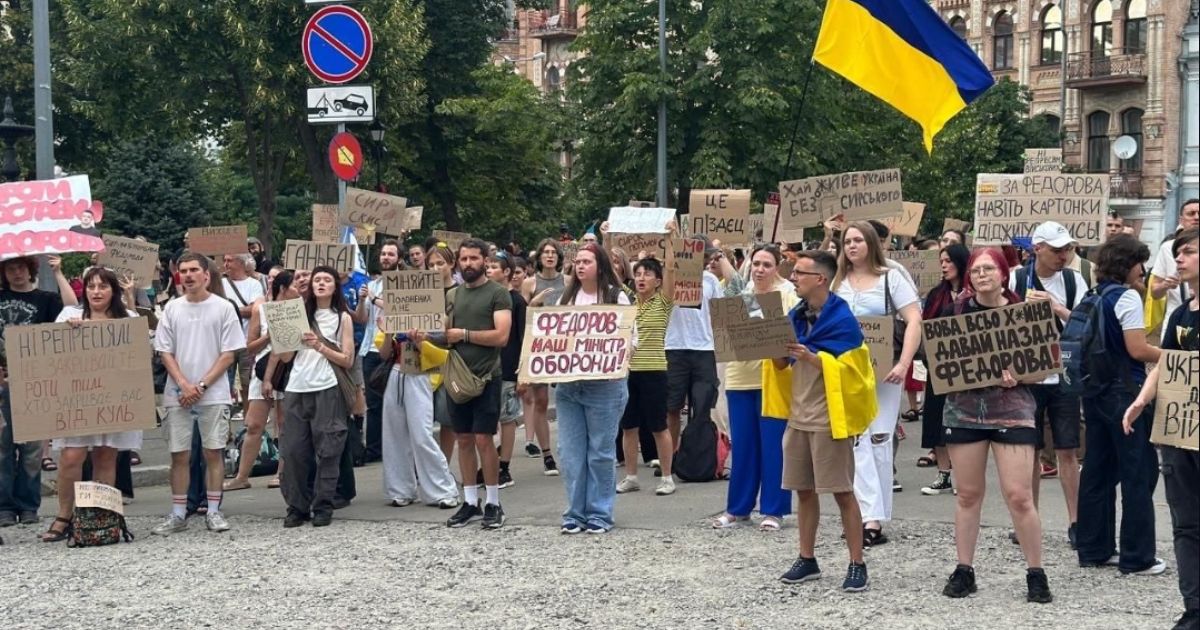
Around a few thousand Ukrainian protesters demonstrated in central Kyiv on 31st July due to their persisting concern over Ukraine’s military campaign and the effect this has had on the decision of its government to replace the defense minister.
The defence minister, who had headed the wartime ministry earlier this year, was ousted in July following a reshuffle of the government. The move led to demonstrations around the presidential palace demanding the re-appointment of the dismissed minister.
The dismissal has sparked a lot of speculation on the government reshuffle’s rationale. Disagreements among the military leadership, the direction of defence policy and attempts to tackle corruption in the defence sector have been the subject of questions.
The new demonstration passed through the historic centre of Kyiv and ended up at Khreshchatyk, the main avenue of the capital. The turnout showed that public interest in the defence policy and military leadership at a crucial moment of the war continued.
One of the key points of the conflict is Ukraine’s attempt to modernise its military forces. As the nation’s military forces adjust to the war’s needs, it has increasingly turned to technology, drones, intelligence systems and long-range operations.
There is consequently a concern that with the change in leadership in the defence post, there may be a change in the speed at which military innovation and institutional reforms take place. The dismissal coincided with Ukraine’s escalation of its strikes against Russian military and energy installations and its ongoing coverage of the frontline developments.
So far, the government has made no moves to overturn the decision. After the reshuffle, an acting defence minister was named, and more changes in the military’s broader command have been announced.
This has also brought into focus the issues of people’s trust in government institutions in wartime. Ukraine is under military pressure, and defence personnel decisions have more than just an appointment meaning; they can shape public opinion about the government’s ability to run the war.
DEMOCRACY DURING WAR
The demonstrations have also highlighted the fact that despite Ukraine’s lengthy wartime situation, the public still plays an important role in the country.
Protesters have held peaceful demonstrations about government policies, defence restructuring and military readiness. The demonstrations are a sign of a general expectation that key decisions made in the name of national security should be accompanied by clarity of explanation and accountability.
It’s also a case study in the tricky relationship governments must maintain in wartime. Military leaders and defence officials need to act swiftly to adapt to the realities of the battlefield, and governments need to keep citizens informed and build public confidence in the institutions that make up the government.
The clash of opinions on defence leadership in Ukraine is especially significant at this stage of the process. Strong public trust in state institutions is needed for continued military operations, for the modernisation of technology, for defence sector reforms and for the government to maintain international support.
It’s unclear if the protests will result in additional changes. But the protests show that defence policy and military command continue to be public issues of great interest, and that the public still expects transparency, accountability and good management of the country’s defence effort.