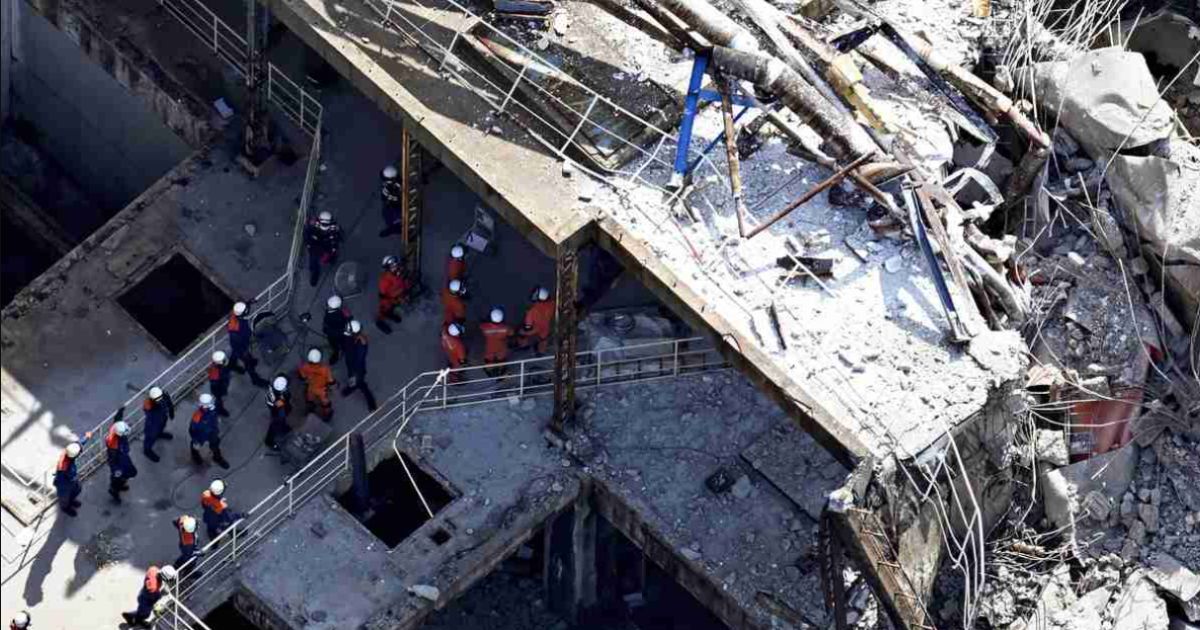
Many people were trapped as many buildings collapsed, including a shopping mall, where dozens were injured, in Kyushu, Japan’s most southerly major island, in a powerful earthquake that hit Kumamoto Prefecture on 28th July morning.
The tremor was at the maximum intensity (shindo 7) on Japan’s seismic intensity scale, and several strong aftershocks followed. Residents were cautioned to stay ready for potentially more significant earthquakes in the next few days.
Aeon shopping mall in Kashima had the most serious incident as a section of the second floor collapsed after reports of an explosion and white smoke. Police reported that many were thought to have been trapped and local media reported that there was a fear of loss of life. Four people were injured and taken to hospital, but 20–30 people were still missing, NHK said. Prior to the collapse, approximately 200 customers were evacuated.
In total, over 100 people were hospitalised, with at least one unconscious, throughout the prefecture of Kumamoto. Emergency response was also called to a number of building collapses and fires around the epicentre, especially in Uki, where the firefighters answered many emergency calls.
The quake had a major impact on transport. The Kyushu Expressway, which is a motorway, was damaged at highway overpasses, a pedestrian bridge collapsed in Yatsushiro, and the entire Kyushu Shinkansen line was suspended. Various local rail lines and highways also were shut down for safety checks.
Prime Minister Sanae Takaichi set up an emergency disaster task force and deployed 3,600 SDF troops to aid rescue and relief operations.
The Japan Meteorological Agency (JMA) issued a warning that strong aftershocks may persist for the next 10 days or so, particularly over the next two to three days. The shallow depth of the quake – just 10km – makes it likely it will be followed by further seismicity, officials said. The epicentre was close to the Hinagu fault zone, which caused the devastating 2016 Kumamoto earthquakes, but experts noted it’s too early to conclude if the quakes are connected.
Chief Cabinet Secretary Minoru Kihara announced that he has confirmed no abnormalities at various nuclear power plants near the Fukushima nuclear accident, including the Sendai Nuclear Power Station, which is located 120 kilometres from the facility. Another tsunami advisory was raised for the coastal regions of the Ariake and Yatsushiro seas, but that was retracted later in the day due to the lack of any major waves.
The rare Shindo 7 magnitude was felt in Hikawa and Uki, the first time in Japan since the Noto Peninsula earthquake in January 2024. Shaking was also strong in the adjacent prefectures of Nagasaki, Fukuoka, Saga, Miyazaki and Kagoshima.
The quake knocked out power for some 48,300 households, and utility companies are asking people to stay away from downed power lines. The disaster follows a similar pattern to that of the Kumamoto Earthquakes in 2016, which struck the city, causing 278 deaths, over 2,800 injuries and devastating damage to Kumamoto Castle.