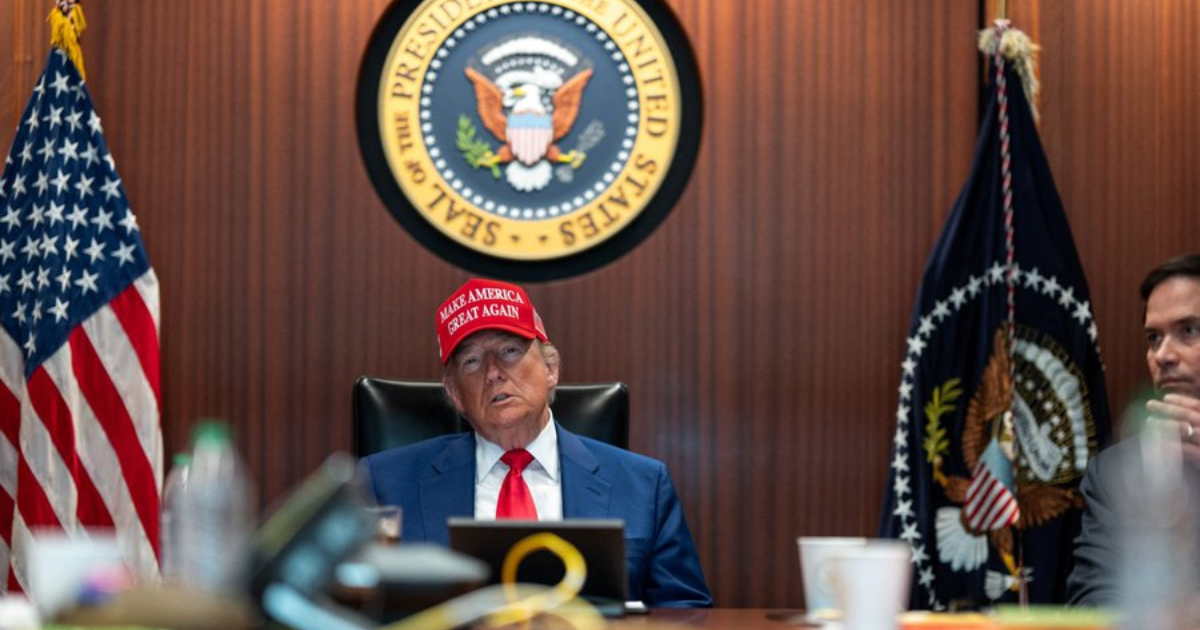
US President Donald Trump has announced that he is close to making an “unprecedented” military decision against Iran from the White House on Thursday. The warning is on the heels of failure in some recent interim peace talks and escalating tension in the Middle East.
In an interview with Axios, President Donald Trump said he’s looking at some sort of “massive attack” that would be bigger than pretty much any prior military action, and he also noted that U.S. forces are fully prepared. At the same time, the U.S. Embassy told American citizens in the region to expect possible flight interruptions and cancellations, while tensions are still climbing.
The drastic move follows the Tehran-backed Houthis (South Arabian rebels) taking responsibility for the attack on two Saudi oil tankers in the Red Sea, the Encelia and the Layla. Trump threatened “heavy military” measures against Iran and its Houthi proxy if commercial vessels are targeted again on his Truth Social platform.
Earlier this week, the Houthis made formal announcement to block ships traversing the Bab el-Mandeb Strait that are linked to the Kingdom of Saudi Arabia. They had cited retaliation for the current Saudi blockade of Yemen and a recent attack on the rebel-controlled international airport in Sana’a as the reasons.
Typically, the closure of this vital gateway accounts for approximately 12 per cent of the world’s trade along with one in four containers, and it already resulted in rerouting at least nine tankers. They have to go around the Cape of Good Hope now – two, three very expensive weeks added to the trip from Europe to Asia.
Regional Leverage and International Backlash
The Houthis are part of a wider regional network of “Axis of Resistance” groups, such as Hamas and Hezbollah, which have gained control over important parts of the region within a few kilometres of the Bab el-Mandeb Strait.
This strategic location is a major advantage for Tehran, says Ahmed Nagi, a senior Yemen analyst at the International Crisis Group. When the Houthis gain control of one of the world’s most important maritime choke points, Nagi says, it would give Iran a significant bargaining chip in the event of a resumption of US airstrikes.
The attacks against Saudi tankers have been condemned by many countries. The United Kingdom Maritime Trade Operations reported a fire aboard a vessel after the strikes were called, but there have been no casualties reported.
But European leaders have also been quick to condemn the violence. The foreign policy chief of the European Union, Kaja Kallas, demanded the Houthis immediately cease their aggression. She denounced the tanker attacks as “illegal and unacceptable” and said they are “a direct threat to international seafarers and directly exacerbate the highly volatile situation in the region.