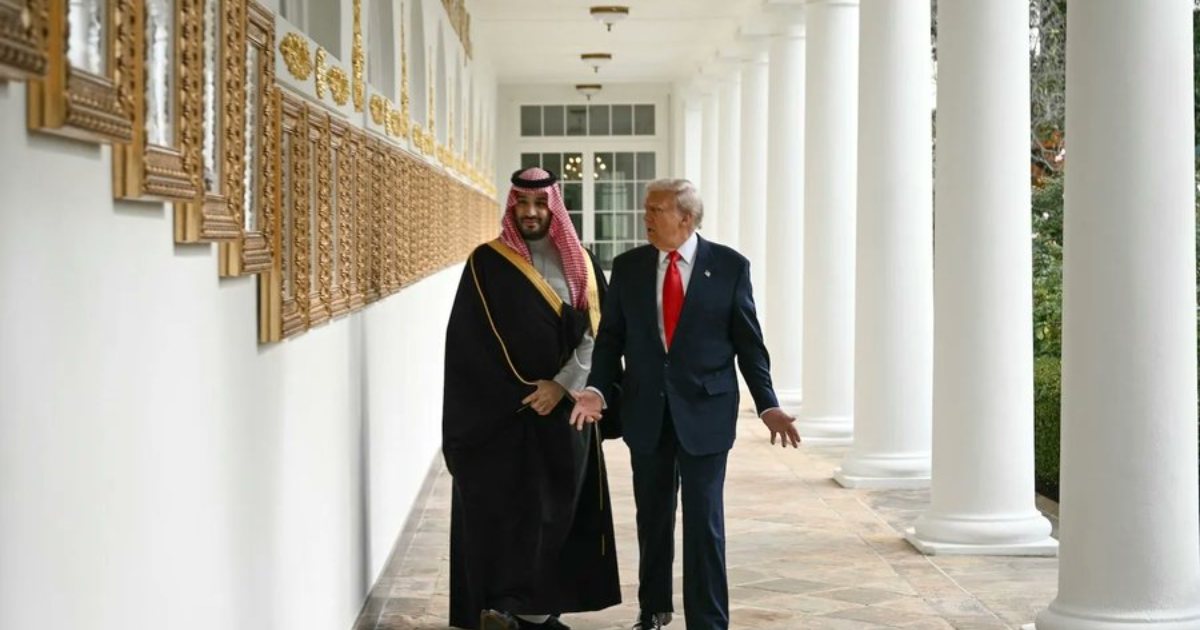
The United States and Saudi Arabia have announced a historic deal for Saudi Arabia to pursue a civilian nuclear program. This “peaceful nuclear co-operation agreement,” the U.S. Department of Energy says, will provide “important commercial access” to a multi-billion-dollar Saudi nuclear energy program.
The official text has been classified, but a US media report indicates that the agreement ultimately could enable Saudi Arabia to enrich uranium on its own territory. It would be a first in U.S. foreign policy history, because domestic enrichment of uranium has the potential to yield fuel for civilian power plants and the raw material for nuclear weapons.
The Crown Prince visited Washington last November, and the Government of Saudi Arabia issued a statement indicating the agreement’s extension of the bilateral energy cooperation that already exists. American officials also announced a “bilateral safeguards agreement” will be signed to support nuclear nonproliferation and security goals in the region.
Timing is everything, because the arrangement is being settled just as U.S.-Iran military tensions have been climbing since February, when Tehran was allegedly suspected of having nuclear ambitions. In a further development to the regional tension, the Iran-backed Houthis movement in Yemen has recently declared a maritime blockade of the Saudi peninsula, home to several military bases of the United States, to which it has targeted Iranian attacks.
Shifting Geopolitics and the Enrichment Debate
The deal is subject to political review and must go through a formal process by the U.S. Congress despite these assurances. The opponents probably don’t have the numbers to stop the agreement in the face of Republican control of both chambers, but some Democrats have vociferously attacked the agreement. Senator Edward Markey called the administration’s actions “hypocritical,” saying that it’s “reckless” to allow the Saudi nuclear technology while it is using the war to stop Iran from obtaining a nuclear bomb.
But the experts involved in non-proliferation are not unanimous in their predictions of what the impact will be. But others say there is a significant security threat in permitting local fuel production, which was not in question under a strict agreement between the United States and the UAE in 2009 to prevent the country from enriching its own uranium. Others, however, contend that the record of the US is excellent at responsibly developing foreign nuclear industries. Even Israel, a key U.S. ally, showed some acceptance, but with Economy Minister Nir Barkat saying the country “can manage it.
In the end, the White House seems to have abandoned its earlier stance that Saudi Arabia must make a formal move toward normalizing relations with Israel before it can get nuclear assistance. The administration’s drive for lucrative commercial benefits and the growing fear of Saudi Arabia going to Russia or China for a comparable nuclear accord has ensured the agreement will have long-term repercussions that will change the power balance in the Middle East for decades.