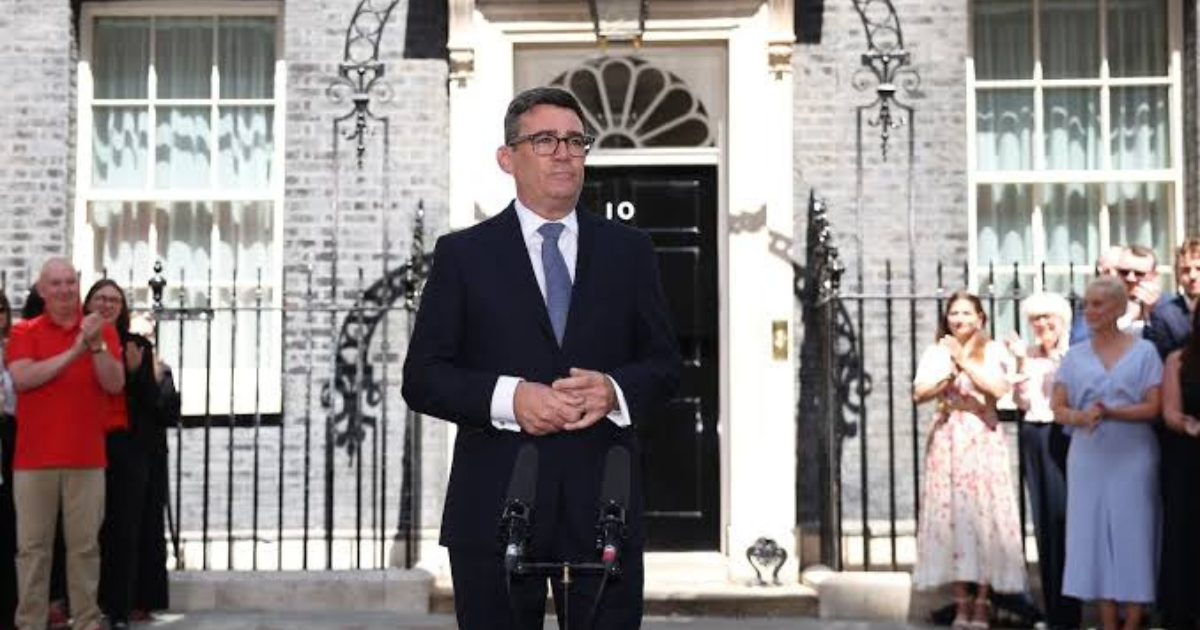
Britain’s new Prime Minister Andy Burnham officially assumed power Monday, picking up a shuffle of the cabinet that got rid of allies of his predecessor Keir Starmer. Burnham offered a full-scale 10-year plan to address cost-of-living issues in the nation, and showed a marked change in direction politically.
The 56-year-old was welcomed by loud applause before entering into 10 Downing Street accompanied by his wife Marie-France van Heel and his mother. He quickly took steps to assert his leadership, removing Starmer loyalists Rachel Reeves and David Lammy. Instead, he picked John Healey as finance minister, Wes Streeting (who had been a rival to him for leadership) as defence minister and Ed Miliband as foreign minister. Angela Rayner, a leftist wanted to return to government as figurehead, and Shabana Mahmood was kept on as ministry of interior minister to oversee hardline asylum reforms.
Burnham met the King, Charles III, at Buckingham Palace before he declared himself prime minister. The nation “must demonstrate to the world how it can restore stability and create a ‘new economy'” in the wake of the monarch’s fourth prime minister since 2022 and Britain’s seventh in less than a decade, Burnham said.
Burnham also began diplomatic negotiations. The two discussed trade, military cooperation and demining the Strait of Hormuz during a call with U.S. President Donald Trump. The White House verified that Trump was interested in helping the new administration, and that he wanted to meet soon. In addition, the Prime Minister has held talks with the President of Ukraine, Volodymyr Zelensky, in which he reiterated Britain’s strong backing for Ukraine’s resistance to Russian aggression.
A Ten-Year Plan for Economic Renewal and Decentralization
In what he termed an “attempt to provide breathing space” for citizens, Burnham vowed to provide relief soon in the form of new measures, which he said will be announced on Tuesday. His 10-year strategy supersedes Starmer’s earlier commitment of a “decade of national renewal. Burnham said he considers the UK to have gone “wrong turns” in the 1980s and vowed to shift political control away from Westminster and to give greater control over key services to the public.
His domestic policies involve a wide range of plans to re-industrialise Britain through public procurement, expand public sector housing and his continued commitment to ending rough sleeping that he had previously championed during his tenure as regional mayor of Greater Manchester, known as ‘King of the North’. Starmer had left the home earlier in the day, claiming that Britain was “stronger and fairer” after 14 years of Conservative government compared to the previous two years of his government.
Burnham’s rapid “coronation” by the Labour party’s MPs has generated a lot of enthusiasm, but he is faced with a mountain of problems. He is still reeling from a weak economy, the rising cost of welfare spending and the high levels of government borrowing, and has limited room to manoeuvre in his financial planning given the strict financial rules. Moreover, the traffic of small boats has also driven a lot of hugely popular support for the hard-right Nigel Farage-led Reform party.
The new leader will also be subject to pressure from the outside. Rising oil prices driven in large part by the U.S.-Iran conflict and the prospect of Washington’s attitude towards him being unpredictable could jeopardize his premiership. Meanwhile, opposition politicians are already demanding to have his mandate re-examined and declare a snap election. French President Emmanuel Macron followed with his congratulations from the Élysée Palace, emphasising the international demands upon his new government, and urging Burnham to “put new momentum” into the UK’s relationship with the European Union.