The Gaza recovery plan led by Donald Trump’s Board of Peace (BoP) has been drastically reduced. The plan was originally to be an ambitious project that would take 100 days to rebuild the whole area, but has now been reduced to a small pilot project in the south of the strip, near Rafah.
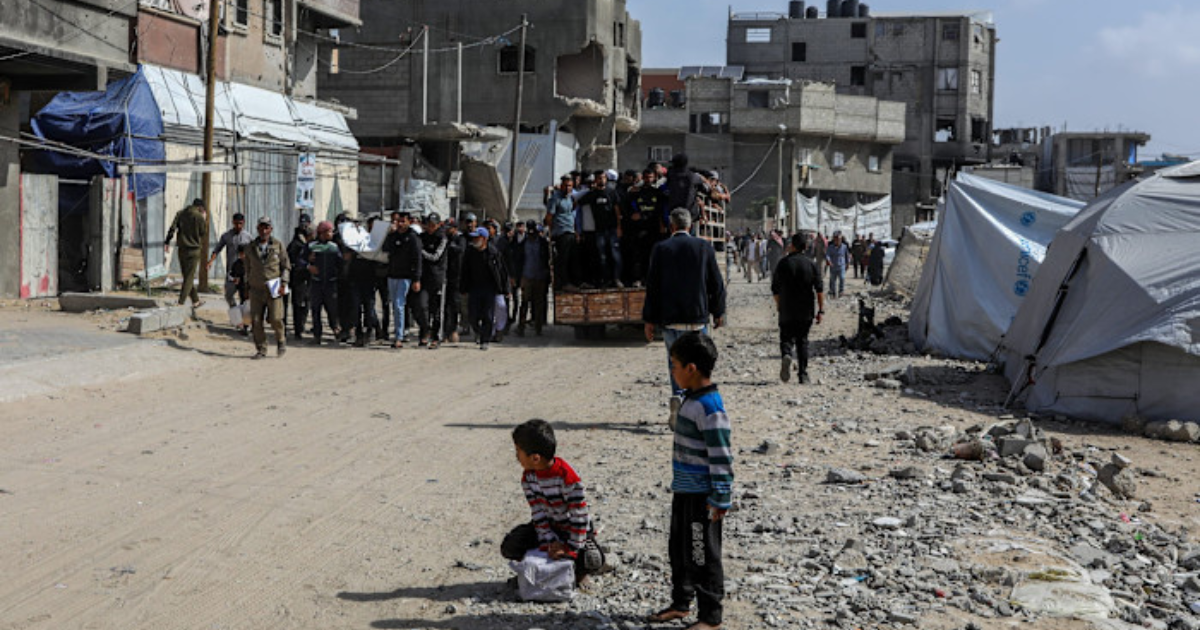
Even this significantly cut back pilot scheme is expected to be realized only when late in 2026. The envisaged plan involves setting up a temporary camp for a tiny fraction of Gaza’s 2 million displaced residents. It is seeking to use mobile tents and a Palestinian administration or to have a small international security force.
Some small incremental steps have been made in recent weeks. A few Moroccan and Kosovan officers have also come to Israel to provide the base for an International Stabilization Force (ISF) to secure the camp. There is also a logistical base for ISF vehicles and equipment that is nearing completion at crossing Kerem Shalom.
However, physical preparatory work on the pilot camp near Rafah has not yet begun, nor has construction started on the camp’s ISF support base. Satellite imagery shows disturbed earth, but no new structures. Much progress has been halted in the region while Israel holds its next elections on October 27, when Netanyahu’s far-right coalition government could be turned upside down.
The threat of renewed conflict and a narrowed scope of conflict.
Diplomatic sources in Jerusalem say the BoP was left with little alternative but to take the step because the US could not allow the Government of Israel to be seen as failing to act, which would give greater strength to extreme groups. These groups are reportedly advocating for mass migration and colonization of the region.
“Just keep something going, keep the ball in play,” said one diplomat.
Israel, meanwhile, has consistently broken the ceasefire, restricting humanitarian aid and preventing reconstruction, despite committing to do so last October. Since the ceasefire, Israeli air raids have been reported to have killed over 1,100 Palestinians. Israel has occupied more than 60% of Gaza and created a huge buffer zone.
If war does break out again, the small pilot programme of the BoP may be swept away again, critics say. Fear is mounting that Netanyahu may be preparing another Gaza offensive in advance of an election in October, as he fears he could be rebuffed next time.
Visiting fellow at the European Council on Foreign Relations Muhammad Shehada claimed that Israel is trying to create a “caged and controlled Potemkin village.” He predicted that Israel would mask its moves in this small encampment as a quest for “progress” to give the impression that it was gradually moving toward a larger military offensive against the rest of the Gaza Strip.
Israeli authorities, however, say that a return to fighting is not an option if Hamas does not give in to disarmament demands. Talks in Cairo on the disarmament of weapons fell flat in recent weeks as Palestinian sources have said disarmament could not be achieved while Israel continued its air raids and land grab operations.
Logistical Hurdles and Funding Shortfalls
The BoP’s stance has been criticized as being too nonтолерant towards Israel. BoP’s Nickolay Mladenov, the high representative for Gaza, was severely attacked for repeating Israeli talking points at the United Nations Security Council.
In private correspondence to the Netanyahu government, BoP adviser Aryeh Lightstone asked for a letdown in the delivery of “dual-use” humanitarian assistance (including water pipes, solar panels and others) and for authorisation for the ISF to enter into Gaza. The Israeli government has so far not approved any of these requests.
The current pilot plan was hastily prepared during the meetings in Cyprus, where advisors of the Tony Blair Institute and members of the National Committee for the Administration of Gaza (NCAG) were involved. The NCAG is a group of 13 Palestinian professionals who have been denied entry to Gaza by Israel has been based in Cairo.
Another challenge is to recruit and train the security forces for the camp. Israel is expected to take months to complete the vetting of Palestinian police force, which will involve a significant role by Israel in the recruitment process. The ISF itself is hoping to muster a quarter of the originally expected number of troops—5,000—and is still working on its legal structure with the Israeli government.
The financing of the project is still very volatile. The $17 billion that was originally offered for Trump’s 20-point peace plan has been very little fulfilled. The European Union just announced it gave Palestine €883 million for basic water and sanitation infrastructure, while the BoP is also making an effort to siphon off part of the Palestinian tax revenue, currently withheld by Israel, to finance its pilot project.
The Palestinian Authority has been outraged by this financial manoeuvre, demanding the immediate and unconditional release of the money, and Foreign Minister, Mr. Aghabekian, called the move “unjustified and unacceptable”. Additionally, Aghabekian voiced his concerns over the BoP’s new direction, noting that the “temporary” nature of the arrangements cannot “replace a comprehensive solution… or normalise an unacceptable reality.