In Veracruz, the eastern region of Mexico, archaeologists have discovered an intriguing ancient site with characteristics never before described that include architectural elements and specific traces of Mayan culture.
The discovery is unprecedented, officials say, and has the potential to change our understanding of the pre-Hispanic history of this region.
Divine Discoveries at the Campo Viejo Site
During her press conference on Friday, President Claudia Sheinbaum highlighted the findings’ importance. She said the find is “very relevant” and her government will have enough resources to help continue the investigation and restoration of the ruins.
The circular stone platform at the center of the site is unique to this region in Mexico, at the town of Coatepec. However, it is a “very particular structure” which has never been recorded in the area and has no known correlation with other ancient sites,” noted Alberto Vazquez, an archaeologist.
The ruins are Early Classic (AD 200–600). In addition to the circular stones, there is a flagstone and limestone platform with almost squared lines and figures within it, which are also part of the pre-Hispanic area.
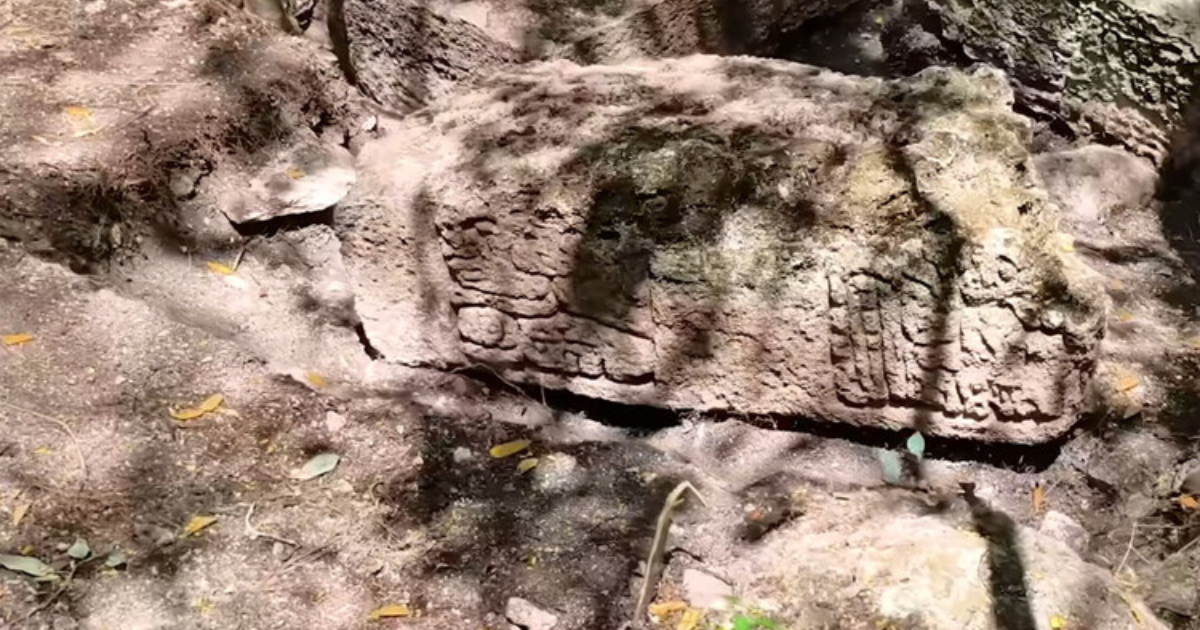
Scientists from the National Institute of Archaeology and History (INAH) also found an intriguing monolith of figures that might have been Mayan. The stone is 68 centimeters (2.23 feet) at its narrowest point, 1.47 meters (4.82 feet) at its widest point, and 1.88 meters (6.16 feet) tall.
INAH archaeologist Lino Espinoza Garcia explained that the stone depicts a very symbolic scene. Two high-ranking figures, one visibly displaying Mayan characteristics, are depicted holding a bowl, and one being handed a fluid known as “water” by the other. The images may be representative of a period of severe drought in the region that was so significant that it is captured in art, such as in the figures of people receiving the fluid from a divine source, as Espinoza suggests.