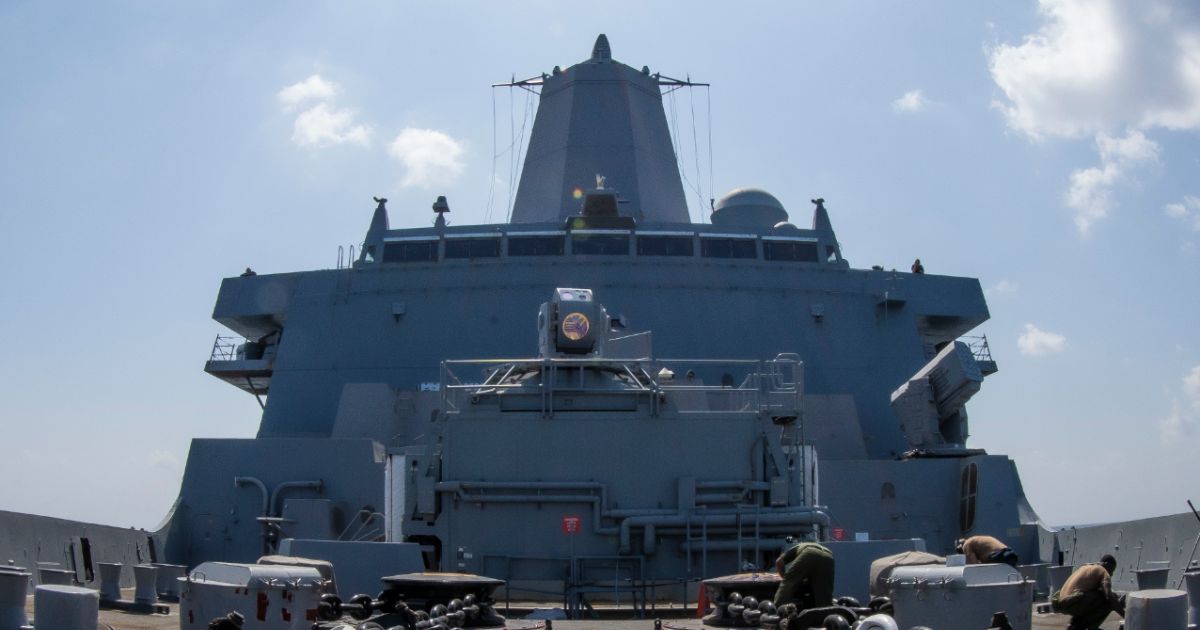
The US Navy spent at least six months resurrecting a high-energy laser weapon that previously graced the bow of a warship for a new military exercise last year, the service recently revealed.
The Navy Directed Energy Systems Integration Laboratory (DESIL) – the special lab to test laser weapons in a maritime setting at Naval Base Ventura County in Point Mugu, California – will see a renewed push to bring back key capabilities to the service to its one-of-a-kind Solid State Laser Technology Maturation (SSL-TM) 150 kilowatt demonstrator beginning in early March 2025, according to ‘year in review’ bulletin.
Started in 2012 and officially named Laser Weapon System Demonstrator Mk 2 Mod 0, the SSL-TM demonstrator was initially mounted on the San Antonio-class amphibious transport dock USS Portland in 2019. The system, which was dubbed as the successor to the 30 kW AN/SEQ-3 Laser Weapon System (also called the XN-1 LaWS) that was mounted on the Austin-class amphibious transport dock USS Ponce in 2014, was to “provide a new capability to the Fleet to fill known capability gaps against asymmetric threats, such as now ubiquitous aerial drones and small boats loaded with explosives,” according to Navy budget documents.
The SSL-TM demonstrator seems to have worked as promised. The system has demonstrated the capability to shoot down a drone target in the Gulf of Aden in May 2020, during an at-sea test, which has provided one of the clearest examples of a real-world laser weapon in operation to date, and to shoot down a small target on the surface during further testing in December 2021.
However, whereas Northup Grumman — a prime contractor on the program specifically designed the SSL-TM demonstrator to install “with a minimal amount of modification or extra expense” onto the Portland in the Navy’s Arleigh Burke-class guided missile destroyers, the service started the process of deinstalling the system onto the Portland in fiscal year 2023 after incurring approximately $50 million in the effort, the budget documents indicate. The end report by the US Defence Department on the initiative is yet to be released.
After the uninstall, the SSL-TM demonstrator was presumably mothballed until the Office of the Under Secretary of Defence for Research and Engineering (OUSD(R&E)) requested the laser weapon to contribute to the role in the new Crimson Dragon military exercise the next month, in September, the NAVSEA bulletin says.
Described as a weeklong, multi-unit DESIL test event, Crimson Dragon convened 20 defence contractors “in a simulated combat environment” to test the effectiveness of their drones, counter-drone systems, and sensors “in scenarios that simulated military base defence, long-range fires and integrated [ballistic missile defence],” according to the bulletin.
The bulletin states that the SSL-TM demonstrator was able to shoot four drone targets in the course of the exercise.
Although there is no indication of the scenarios the SSL-TM demonstrator has been involved in during the Crimson Dragon, an annual evaluation of US military weapon systems published by the Director, Operational Test and Evaluation of the Pentagon on March 16 reports that one of the events involved the system providing air defense of a simulated port or staging area where the troops and equipment are boarded onto ships.
There are no other details, however, about the current status of the SSL-TM demonstrator, its operation in Crimson Dragon, or the future plans of the Navy to use the system, other than these brief mentions in recent US military publications. Other offices, such as the NAVSEA, OUSD(R&E) and the Office of Naval Research, failed to provide additional information to the Laser Wars.
Out of context, it is hard to tell how the re-emergence of the CSS-TM demonstrator fits into the growing directed energy aspirations of the US military. Pentagon has not said whether the urgency of real-world threats – the demonstrator was initially tried in the waters where Iran-backed Houthi rebels in Yemen had spent over a year attacking US warships and commercial shipping – prompted the request by OUSD(R&E) or was merely an expedient use of a proven system in storage.
Nonetheless, the fact that the system is being restored to Crimson Dragon may indicate that there is a larger problem: even after years of development and high-profile demonstrations, comparatively few high-energy laser weapons are at all available to the type of realistic, large-scale exercises necessary to hone tactics and prove the usefulness of these weapons in combat.
Indeed, it’s not like the Pentagon has a bunch of spare laser weapons floating around to play with. Four 50 kW Directed Energy Manoeuvre-Short Range Air Defence (DEM-SHORAD) systems of the US Army have been fully demilitarised, and their Army Multi-Purpose High Energy Laser (AMP-HEL) systems are busy shooting down drones on the US-Mexico border. The Marine Corps gave back its five Compact Laser Weapon Systems (CLaWS) to Boeing.
AN/SEQ-4 Optical Dazzling Interdictor, Navy (ODIN), laser weapons, all of which are equipped on active warships out at sea, have had a rough year of their own; a 60 kW High Energy Laser with Integrated Optical Dazzler and Surveillance (HELIOS) system in the service has had a difficult year in its own right. Consequently, it seems that some of the prototypes that were earlier retired and could have otherwise ended up in museums are being reintroduced into service to ensure that the counter-drone experimentation by the US military continues.
The Pentagon is possibly in a scramble to deploy laser weapons on a large scale, yet at the moment, it is still using prototypes of the past to determine how they will actually engage in the wars of tomorrow.