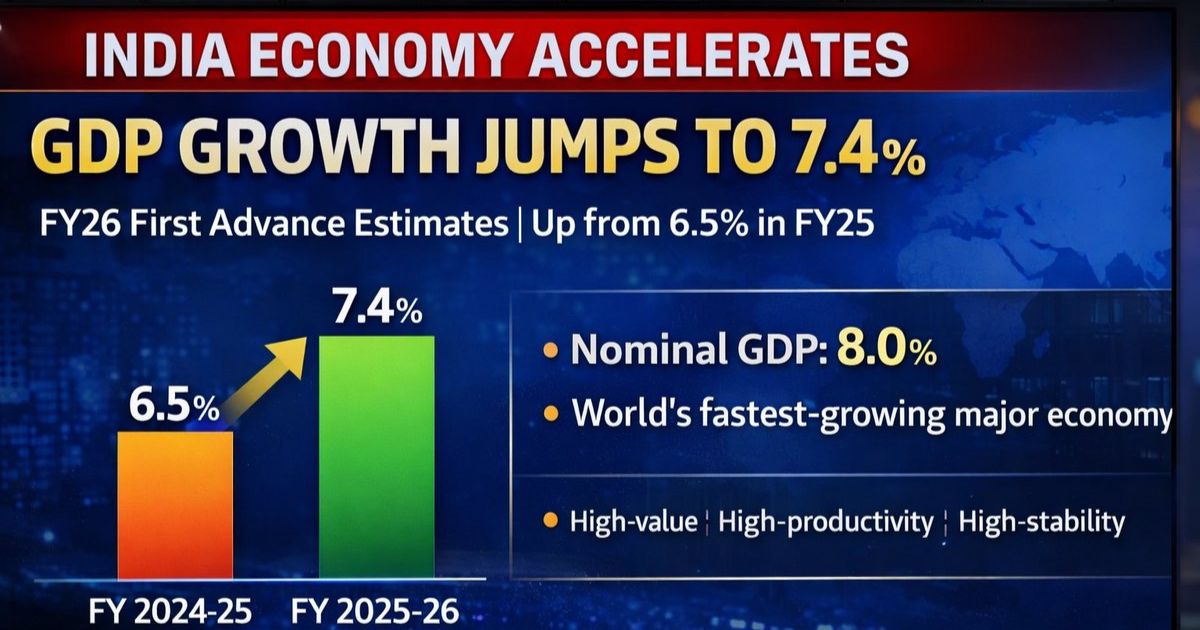
The economy of India will continue to be one of the fastest-growing major economies in the world, with a growth projected at 7.4 per cent in 2025, according to the United Nations World Economic Situation and Prospects 2026 report.
In the wake of the release of the report, UN Country Economist of India, Chris Garroway, stated that the growth projection was in line with India’s recent good performance, and that the figure was in tandem with the advance estimates published this week by the Ministry of Statistics and Programme Implementation (MoSPI) on fiscal year 2025-26.
The UN predicts that the growth pace in India will be low in the coming years as the economic growth is expected to rise to 6.6 per cent in 2026, and then slightly higher to 6.7 per cent in 2027. The UN report further shows the strong growth perspective of India to be supported by the strong household consumption and frontloading of exports in the last year.
The UN, however, expects some relaxation in export performance next year due to the new tariffs coming into effect. Domestic policy measures are also indicated as one of the factors leading to sustained growth in the report. Economic activity has been supported by tax reforms and monetary easing, and sustained government expenditure on infrastructure, defence, digitalisation, and renewable energy has increased fixed capital formation in the economy.
This set of numbers is underpinned by the assumption that private consumption is going to be high, that last year the exports were front-loaded, and that there would be a downturn in the coming year as the tariffs will be implemented. Among the factors that have contributed to the further healthy growth, the report also refers to the tax reforms and monetary easing in India. According to Garroway, the report also mentions significant state spending on infrastructure, defence, digital and renewable energy projects, which all increased the fixed capital formation in the country.
In a report released by the United Nations on the World Economic Situation and Prospects (WESP) 2026, released earlier this week, the economic growth of India is estimated to level off between an estimated 7.4 per cent in 2025 and 6.6 per cent in 2026. Economic activity is likely to be supported by the resilient household expenditure, the robust public investment, and the reduction of interest rates.
Although US tariffs could drag on some of the categories of products, major portions of the export will not be impacted significantly. Furthermore, the effect is set to be cushioned to some extent by the high demands in other big markets, as the UN report had claimed.
One of the near-term risks is uncertainty in trade policy, although recent US tariff increments on Asian economies were smaller than those first envisioned, and certain trade accords have been accomplished.
It is against that background that the report highlighted that the world will need greater global coordination and collective action at a time when geopolitical tensions are escalating, when policies are taking an increasingly inward-looking form, and where the push towards multilateral solutions is faltering.