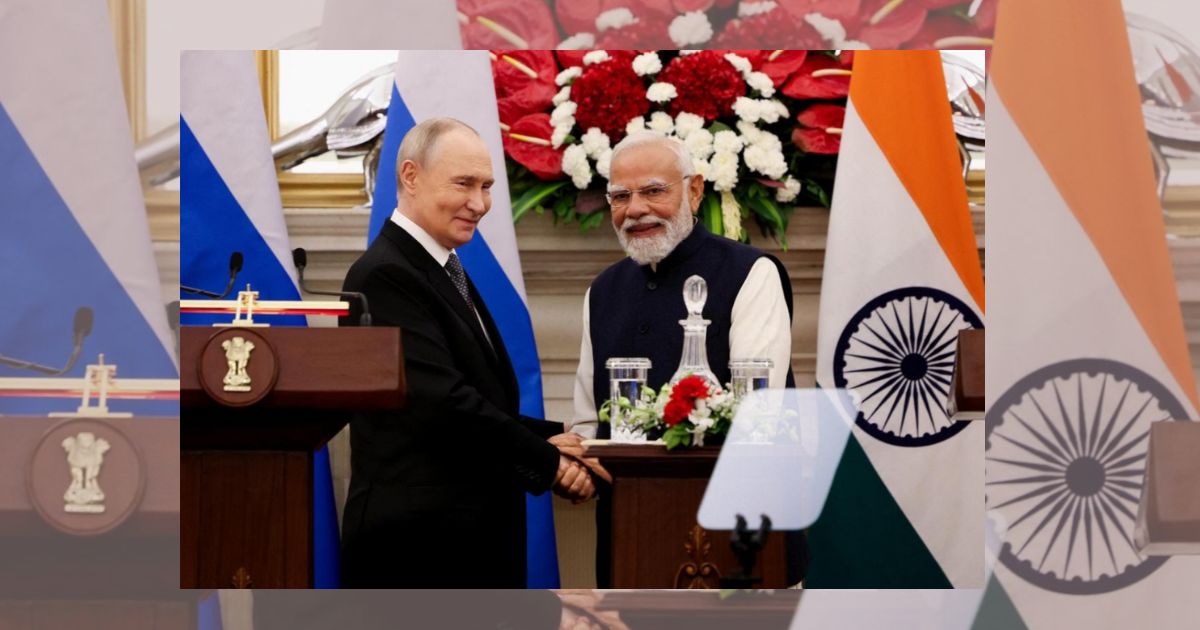
On 5th December, at an annual summit, Russian President Vladimir Putin met Indian Prime Minister Narendra Modi and agreed to diversify their bilateral economic relationships as the United States urges India to rework its decades-old relationship with Russia.
The 23rd Russia-India Summit is timely because the U.S is urging a peace agreement around Ukraine, but would want the rest of the world to join. It will challenge the attempts by New Delhi to strike a balance between Moscow and Washington at a time when the almost four-year conflict in Ukraine is lingering on.
🚨 PUTIN : “Important discussions took place during last night’s dinner”
PUTIN ⚡⚡ “Russia is ready to ensure uninterrupted fuel supplies to India. Both countries are steadily shifting to national currencies for bilateral payments”
PM MODI : 30 day free e-tourist visa for… pic.twitter.com/92dnDKNwpA
— News Algebra (@NewsAlgebraIND) December 5, 2025
On Thursday, Putin was welcomed by Modi in New Delhi. The Indian leader embraced Putin with a bear hug and a very firm handshake of an old friend.
Russia-India’s thriving relationships are outlined by leaders
Following the negotiations, Putin and Modi confirmed that India and Russia will complete an economic cooperation program by 2030 that will contribute to diversifying businesses of both countries to increase the annual turnover to $100 billion by 2030. They also placed a high premium on robust energy relations.
Two-way trade between China and the US was at 68.7billion dollars in the previous fiscal year, which ended in March. The trade is skewed immensely towards Russia, with massive deficits of India, which is looking to offset by forcing exports.
To reach such a great aim, the program of Russian-Indian economic cooperation development till 2030 was agreed to, Putin said. He added that India was in negotiations for a free trade zone with the Eurasian Economic Union, a Moscow-led economic bloc of various former Soviet states, and that it might serve to boost trade.
Putin said that Russia is a stable energy provider, as well as all that India needs to develop the energy industry. We are willing to go on to provide the ever-increasing Indian economy with fuel continuously.
The Russian leader mentioned that the two nations share a very trusting relationship as far as military-technical cooperation is concerned, just before the summit talks.
Modi concluded the talks by saying that the two countries will strive to conclude a free trade agreement with the Eurasian Economic Union soon. He also declared that very soon India will begin issuing free electronic visas to Russian tourists and groups visiting this country.
The Indian leader remarked that energy security has been the root of India-Russia relations, and the civil nuclear relations have a long history. He further noted that this cooperation will be followed through the process of clean energy, shipbuilding, fertilizers, and labor mobility.
The U.S. aims to drive India away from Russia
Although India has been traditionally close to Russia, the critics believe that the visit by Putin would strain its relations with the European Union and the United States and could become a big risk in the negotiations of major trade agreements with both countries, which are considered to be of critical importance to Indian exports.
In August, U.S. President Donald Trump increased tariffs on Indian goods by 50 percent due to the discounted Russian oil in New Delhi. India has been the second-largest importer of Russian crude after China.
According to the U.S., the Russian oil bought is used to fund the war machine of Moscow. In October, the U.S. imposed sanctions on two of the largest oil producers in Moscow to compel other countries to reduce imports. Indian officials have indicated that New Delhi has never defied world sanctions and will not defy them in the event of Russia’s oil purchases.
The recent sanctions against Russian oil were discussed by India’s foreign secretary Vikram Misri in front of the reporters.
In not declaring how India stood in its buying, Misri pointed out that the government was interested in ensuring its energy requirements of its 1.4 billion inhabitants were met.
Misri reported that the Indian private and state-owned oil companies base their decisions on the changing market forces and business challenges they face during the sourcing process.
He said that we are still working together between the two countries.
India and the U.S. established a deadline for the first round of a trade agreement by the fall, and the agreement is yet to be achieved due to tensions between the two countries, primarily due to the fact that unabated Russian crude imports continue to be made by New Delhi.
India is also nearing the conclusion of the negotiations on a trade agreement with the EU, which regards the war in Ukraine by Russia as a significant threat.
Considering the timing and geopolitical setting, the visit of Putin to India was a reminder of New Delhi walking the fine line between the West and the rest, primarily Russia, as put by Praveen Donthi, a senior analyst with the International Crisis Group.
Donthi claimed that India has been tilted towards Russia since the Cold War era, and this tendency does exist even though India is an officially nonaligned country. His additional comment on the change is that it wants to be a strategic ally with the U.S., but it will simultaneously be an uncomfortable diplomatic task.
Live on credit card defense and trade
Indian officials previously reported that Modi, during the meeting with Putin, would be demanding quicker delivery of two additional Russian S-400 missile systems of surface-to-air type. It has already won three deals valued at approximately 5.4 billion in 2018. The delay has been associated with supply chain disruptions associated with the war in Ukraine.
The defense ministers of India and Russia met on Thursday, Misri said.
The two sides made a joint statement after the summit announcing that they have agreed to promote mutual manufacturing in India of spare parts and components for the maintenance of Russian-origin arms and defense equipment. This would be in terms of the transfer of technology and the establishment of the joint venture.
In February, India and Russia signed an agreement to enhance military collaboration, military drills, port visits, disaster relief, and support of logistics. The State Duma of Moscow approved the same prior to the visit of Putin to India.
India is also anticipating the improvement of its Russian-made Su-30MKI fighter jets and urgently urges the delivery of essential military equipment.
India is eager to export more pharmaceuticals, agriculture, and textiles to Russia, and the elimination of non-tariff barriers. Moscow is also supplying New Delhi with long-term supplies of fertilizers.
The other major area that the two countries are hoping to reach an agreement on is the safety and regulation of skilled Indian migrant workers in Russia.