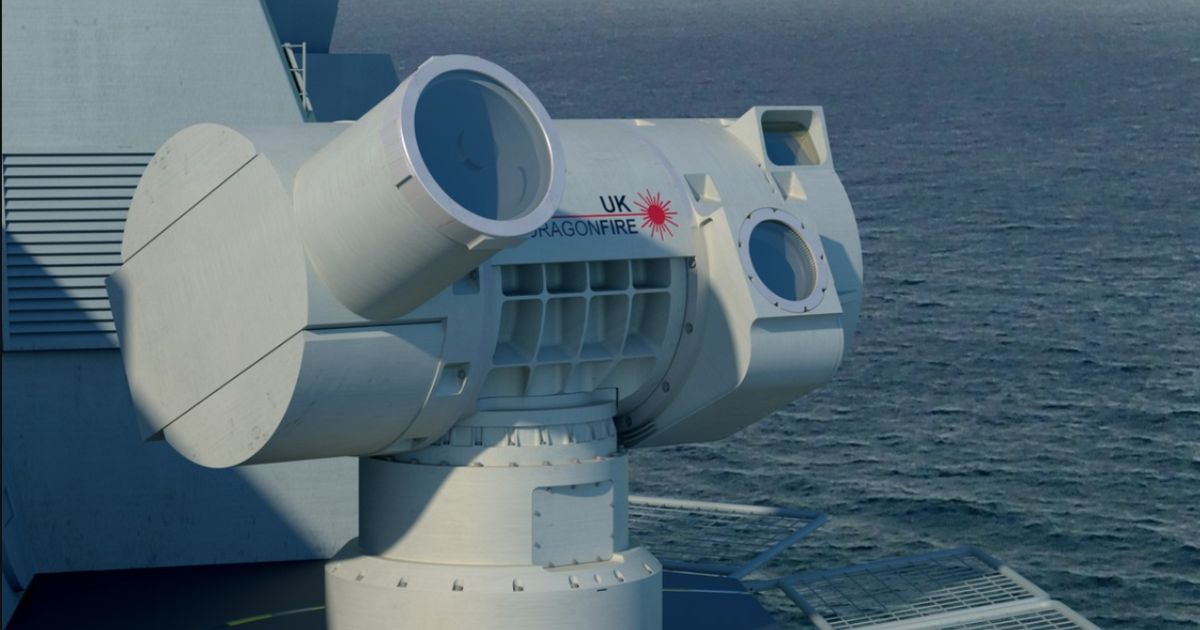
It was announced on 20th November that Britain had awarded a 316 million pound (413 million dollars) contract to missile company MBDA UK to supply the Royal Navy with DragonFire laser systems as part of a strategy to introduce a new technology to ships to counter drones.
In recent experiments, the laser has been able to intercept drones flying at 650 kilometers (404 miles) per hour.
In a release by the UK Defense Ministry, Dragonfire has been able to use UK technology in order to enable it to launch a high-power laser covering long distances. Under the directorship of the Defence Science and Technology Laboratory (DSTL) in the role of the UK MOD, the project is collaborating with its industry partners MBDA, Leonardo, and QinetiQ.
By 2027, Type-45 destroyers are anticipated to have the DragonFire weapon system that will be used to intercept airborne threats, including unmanned aerial vehicles (drones), and fired projectiles. It is a product with a background of a joint investment of 100 million pounds between the Ministry of Defence and the industry in the United Kingdom.
Minister of Defense Readiness and Industry, Luke Pollard MP, said, “This high-power laser will place our Royal Navy at the forefront of innovation in NATO, providing a cutting-edge capability to support the defense of the UK and our allies in the new era of threat.”
The first high-power laser system to come into service is DragonFire and is out of a European Nation.
Laser-directed energy weapons have the ability to strike the target faster than light and cut through the target with an intense beam of light, resulting in structural failure or more explosive outcomes in case the warhead receives a hit. To run the laser costs less than 10 pounds per shot, and 10 seconds of firing the laser costs as much as an hour on a regular heater.
The increased development of these weapons, such as UAVs and guided munitions, is also a significant threat, and this needs to be countered with high-power laser systems to prevent sensitive damage.
In May, the IDF announced that it had managed to shoot down dozens of Hezbollah drones that had entered Israel and used the Iron Beam laser system. The IDF stated that this was among broader operations in an attempt to shoot down more than 1,000 drones when all the different fronts that the hostile actors attempted to assault Israel are considered: Lebanon, Gaza, Iran, Yemen, Syria, and Iraq.
Israel Navy Laser Technology
In an interview with Globes, Lt. Col. H., the Head of the Naval Division at the DDR&D, indicated that the Israel Navy is ready to install a defensive laser system on its new-generation ships to be used in addition to the traditional interceptors on the ships.
Better design platforms that have space to evolve, combine functionality over time, and develop benefits through coalition. According to him, major companies are not the only ones; agile startups are also capable of bringing specific solutions to the field.
Developed through the continuous stress of the presence of threats, Israel has established a multi-level air defense system, which has been very influential in the conflict in real time. Iron Dome, David Sling, and Arrow 3 are the systems that comprise a strong defense against short, medium, and long-range threats.
In a recent speech, Dr. Yuval Steinitz, the chairman of Rafael Advanced Defense Systems, provided an explanation that the laser technology will change air defense through the implementation of ultra-fast, low-cost interception.
“All through history, wars were waged by throwing something at the foe, from rocks to rockets,” he said. The laser system will ensure that the threats posed by aerial weapons against Israel will no longer pose a threat, since with a beam of light, the skies will be clear.