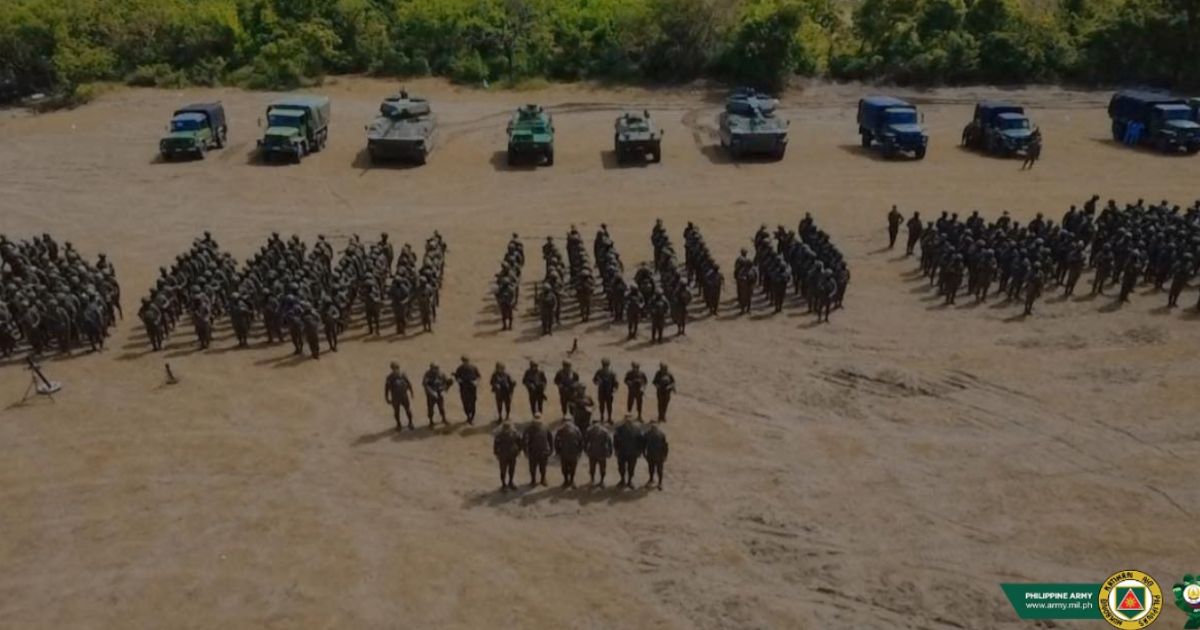
This month, the Philippine forces will conduct anti-invasion exercises in Northern Luzon and the South China Sea to test the capability of the country to fight off threats in the face of tension with China.
The annual joint exercise of the Armed Forces of the Philippines, “Dagit, Langit at Lupa,” or in English, translation of Tagalog to sea, air, and land, began on 3rd November. The version this year will involve sending 2,000 troops from Manila, an unspecified number of national policemen, and Coast Guard forces, to strategic positions throughout the Philippine archipelago to exercise newly gained capabilities and national defense ideas.
According to the Armed Forces of the Philippines (AFP), the exercise will aid in the development of the so-called Comprehensive Archipelagic Defense Concept, which is a strategy developed due to the challenges that lie outside of the territorial borders of the country. In recent years, Manila has encountered more pressure on its westernmost exclusive economic zone by Beijing.
The Chinese warships and research ships have also travelled in the north and south of the Southeast Asian archipelago and the east as well.
According to an infographic of the Philippine military, the move capacitates the joint forces of the AFP in terms of responding to outside threats and protecting our territory.
Most of the exercises will be held in the Northern Luzon Command (NOLCOM) area of operations, as compared to the past years. The military command of the Philippine military is in charge of the defense of the northernmost provinces of Manila, where the military activities have been increasing, and there is a fear of a spill over in case there is a cross-strait military encounter between China and Taiwan.
Out of the nine envisaged field training operations, three will be anti-invasion training operations around the Luzon Strait. Philippine troops will conduct counter-landing exercises and train on how to retaliate against occupied ports and airstrips in Northern Luzon.
Such exercises are in the line of similar exercises conducted by regionally based Philippine Marine Corps and Army forces. The 4th Marine Brigade, which was formerly in the southern islands of the country, has been actively engaged in anti-tank ambushes, coastal defense, and port and airfield defense exercises in the area since it was transferred to it in 2022.
The Philippine Army- a force that was formerly geared to counter insurgency operations- has also begun to train on defending the northern provinces. Philippine troops were tested on their capability of deploying to the region this summer with the help of the Americans.
Early this year, Philippine military Chief Gen. Romeo Brawner informed NOLCOM that they had to be ready in the event of a contingency in case China invaded Taiwan.
Brawner said, “Do not rest on your laurels up to the Northern Hemisphere to Mavulis Island, a Philippine island located near the south end of Taiwan. Begin to plan what to do in case of a Taiwan invasion.”
The Philippine forces will also train their territorial defense strategy on Thitu Island in the South China Sea. The drill is transferred to the primary possession of Manila at the Spratly Islands after several upgrades to an aerodrome and portage over the past few years.
The drill coincides with a rise in tensions in the South China Sea around the Scarborough Shoal, with a declaration of national nature reserve around it by Beijing and an August collision of Chinese forces near the maritime feature.
The claim by the Chinese has caused alarm among the defense officials of the Philippines, with Secretary of National Defense Gilbert Teodoro addressing defense ministers of the region with the claim of a national nature reserve during the Association of Southeast Asian Nations defense ministers meeting last week. Brawner informed the press a month ago that Manila would never permit Beijing to militarize the shoal, which he pledged to forestall another repeat of the past Chinese occupations of the maritime features.